
Wind energy for islands can help reduce dependence on imported fuels, diversify local electricity generation and support more resilient energy systems. Where the wind resource and site conditions are suitable, distributed wind turbines can generate electricity close to where it is consumed and complement solar PV, battery storage and existing generation.
For island communities, utilities and public authorities, however, selecting the right renewable energy mix requires more than simply installing generation capacity. Wind resource, electricity demand, grid characteristics, logistics, permitting, environmental constraints and the potential integration of other technologies all need to be evaluated at project level.
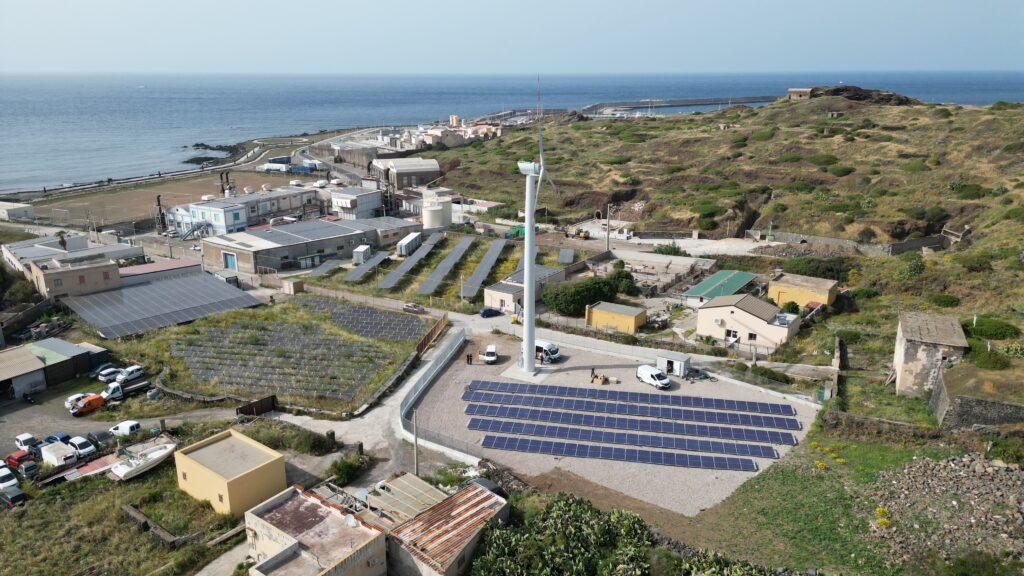
A recent project in Pantelleria, Italy, provides a practical example. Northern Power Systems installed an NPS100C-24 wind turbine on a 30-metre tower, replacing two smaller inactive turbines as part of a broader renewable energy redevelopment initiative for the Municipality of Pantelleria.
Why Wind Energy for Islands Can Be a Strategic Choice
Many island energy systems face challenges that are less significant in large interconnected grids. Fuel may need to be transported over long distances, local electricity networks can be relatively small, and energy supply may depend heavily on imported fuels.
Renewable generation can reduce some of this exposure by using energy resources available locally. According to the International Renewable Energy Agency (IRENA), many island states remain highly dependent on imported fossil fuels, leaving their energy systems exposed to fuel-price volatility and supply disruptions.
Wind energy can therefore form part of a broader strategy to diversify generation and improve energy security.
However, not every island is automatically suitable for wind power. A project should begin with a detailed assessment of the local wind resource, site accessibility, grid requirements, environmental constraints, permitting conditions and expected electricity demand.
5 Key Benefits of Wind Energy for Islands
1. Local Electricity Generation
A wind turbine converts a locally available resource into electricity at or near the point of consumption. For islands that rely on imported fuels, adding local renewable generation can reduce the amount of electricity that needs to be produced from fuel-based sources, depending on the overall system configuration.
2. Reduced Exposure to Fuel Supply and Price Volatility
Diesel and other fuel-based generation require a continuous fuel supply. On an island, transportation and logistics add another layer of exposure.
Wind has no fuel cost, so increasing the share of locally generated renewable electricity can help reduce long-term exposure to changes in fuel prices and supply chains.
The actual economic benefit depends on the site’s wind resource, project costs, electricity prices, financing, operation and maintenance requirements and the amount of wind generation that can be integrated into the local electricity system.
3. Complementarity With Solar PV
Wind energy for islands does not need to operate as a standalone technology.
Wind and solar PV can form complementary components of a hybrid renewable energy system. Their production profiles vary by site, season and weather conditions, so the appropriate combination must be established through resource and load analysis rather than assumed.
Where suitable, combining multiple renewable sources can diversify electricity production and reduce reliance on a single generation technology.
4. Integration With Battery Storage and Microgrids
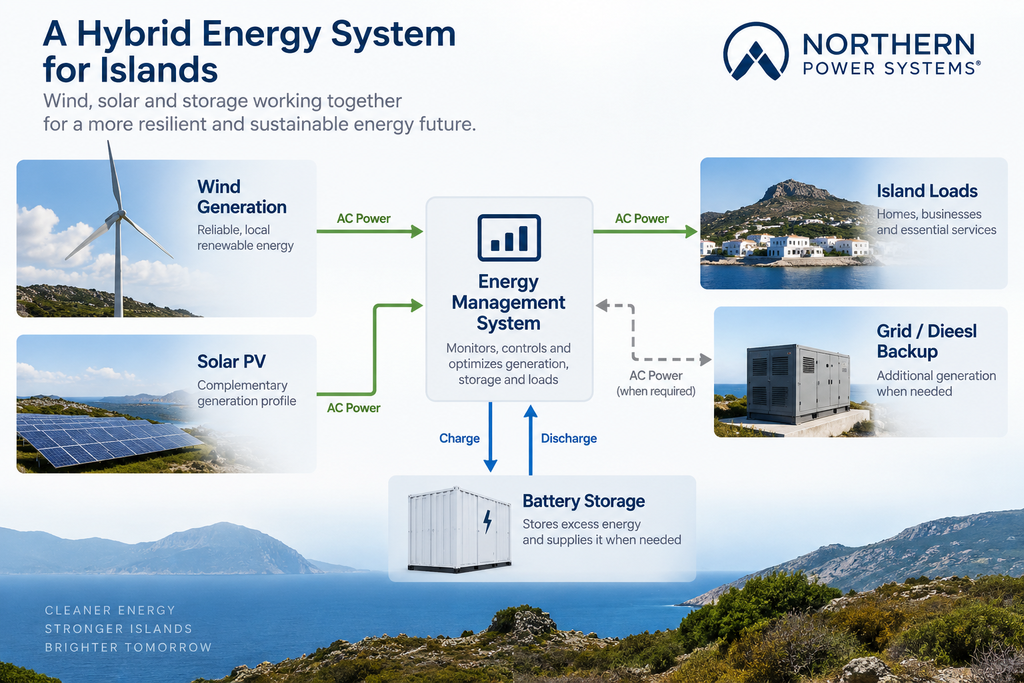
For isolated or weak-grid applications, wind generation can also be integrated with solar PV, battery energy storage systems and controllable generation within a microgrid.
Storage can absorb surplus generation and supply energy later, while an energy management system coordinates generation, storage and loads according to the requirements of the site.
The exact architecture varies significantly between grid-connected islands, isolated grids and individual off-grid sites.
5. A Scalable Path Toward Greater Island Energy Independence
Island energy transitions rarely happen through a single technology or a single project.
Distributed wind can instead become one component of a phased strategy that combines renewable generation, storage, grid upgrades and demand management.
The objective is not necessarily to eliminate conventional generation immediately, but to determine how much local renewable energy can be integrated reliably and economically while maintaining the required quality and continuity of electricity supply.
What Should Be Assessed Before Installing a Wind Turbine on an Island?
The feasibility of wind turbines for islands is highly site-specific.
Before selecting turbine capacity or system architecture, developers and asset owners should typically evaluate:
- measured or modelled wind resource and expected annual production;
- electricity demand and load profile;
- grid strength and interconnection requirements;
- available land and environmental constraints;
- turbine transport, crane access and installation logistics;
- corrosion and other site-specific environmental conditions;
- permitting and planning requirements;
- operation and maintenance access;
- opportunities to integrate solar PV or battery storage;
- existing diesel or other dispatchable generation.
This assessment is particularly important for remote sites, where logistics and grid constraints can materially affect project design and lifetime economics.
The Pantelleria Wind Energy Project
Pantelleria provides a real-world example of how wind energy for islands can form part of a broader renewable energy redevelopment strategy.
The project was developed for the Municipality of Pantelleria and involved the installation of an NPS100C-24 wind turbine on a 30-metre tower.
The new turbine replaced two smaller inactive wind turbines, modernising part of the island’s existing renewable energy infrastructure.
The wider redevelopment initiative also includes a ground-mounted photovoltaic plant of approximately 200 kW, creating an example of wind and solar generation being developed within the same local energy initiative.
The project was also featured by the European Commission’s Clean Energy for EU Islands initiative in June 2026.

Pantelleria Project at a Glance
| Project element | Details |
|---|---|
| Location | Pantelleria, Italy |
| Client | Municipality of Pantelleria |
| Wind turbine | NPS100C-24 |
| Tower | 30 m |
| Project action | Replacement of two smaller inactive wind turbines |
| Additional renewable generation | Approximately 200 kW ground-mounted solar PV |
The project demonstrates an important principle for island renewable energy: the transition does not always require starting from zero. Existing sites and infrastructure may also offer opportunities for replacement, modernisation or integration with additional renewable technologies.
Similar projects may also involve wind turbine repowering where existing infrastructure can be retained or upgraded.
Wind, Solar and Storage in Hybrid Renewable Energy Systems
The most appropriate island renewable energy configuration depends on the available resources and the characteristics of the electricity network.
Wind can provide one source of local generation. Solar PV can add another. Battery storage can provide flexibility, while existing dispatchable generators or a grid connection may remain necessary to maintain supply when renewable generation is insufficient.
The engineering objective is therefore not simply to maximise installed renewable capacity. It is to design a system in which generation, storage, loads and grid infrastructure work together reliably.
For this reason, wind projects for islands should be evaluated at system level, considering both energy production and the way the turbine interacts with the rest of the electrical infrastructure.
Northern Power Systems’ Experience With Island and Remote Energy
Northern Power Systems develops distributed wind solutions, including wind turbines for islands and remote sites.
Beyond Pantelleria, NPS technology has been used in other island environments where wind generation forms part of a wider energy strategy.
For example, the Over Yonder Cay project in the Bahamas demonstrates the integration of wind generation into an island energy system.
For developers, utilities, municipalities and businesses evaluating wind energy for islands, the first step should be a site-specific assessment rather than selecting a turbine based solely on rated capacity.
Evaluating Wind Energy for Your Island Project
A successful wind energy for islands project depends on the relationship between the wind resource, energy demand, grid, site constraints and project economics.
If you are evaluating distributed wind for an island or remote site, Northern Power Systems can help assess the application and determine how wind generation could fit into the wider energy system.
Discuss your island or remote-site energy project with Northern Power Systems.