
Energy has become a strategic issue for UK businesses. Electricity costs, grid constraints, decarbonisation targets and the need for greater operational resilience are pushing organisations to reconsider how and where their power is generated.
Distributed energy UK solutions allow electricity to be generated closer to the point of consumption instead of relying exclusively on centralised generation and the electricity grid. For businesses with suitable sites, technologies such as on-site wind generation, solar PV and battery storage can become part of a more flexible long-term energy strategy.
For energy-intensive operations in particular, the question is increasingly shifting from “Where should we buy our electricity?” to “How much of our electricity could we generate ourselves?”
What Is Distributed Energy?
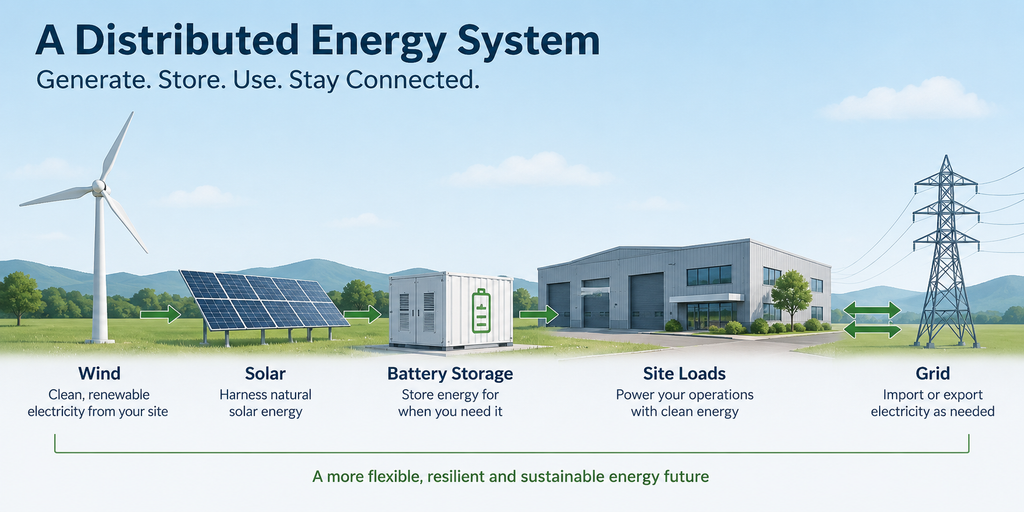
Distributed energy refers to electricity generation and energy resources located close to where energy is consumed.
Distributed Energy Resources (DER) can include renewable generation such as wind and solar, battery energy storage and other flexible energy technologies.
For a commercial or industrial site, the objective is not necessarily to disconnect from the electricity grid. Instead, distributed energy can reduce the amount of electricity that needs to be imported while giving the organisation greater control over how its energy is generated and managed.
Why Distributed Energy Matters for UK Businesses
Distributed energy changes the role of electricity within a business.
Instead of treating energy entirely as an externally supplied operating cost, organisations can generate part of their electricity directly on site.
Depending on the project configuration, site conditions and energy consumption profile, this can create several strategic advantages.
1. Reduce Exposure to Electricity Price Volatility
Generating electricity on site can reduce the proportion of a site’s demand that must be purchased from the grid.
This does not eliminate exposure to electricity prices, but it can provide a degree of protection against future market fluctuations.
For businesses with substantial and relatively consistent electricity demand, increasing self-consumption can therefore become an important part of long-term energy cost management.
2. Make Better Use of Local Energy Resources
A distributed energy strategy can be designed around the resources available at a specific location.
Solar generation may be attractive where irradiation and roof or land availability are favourable. Wind becomes particularly interesting at sites with sufficient space and a strong wind resource.
Battery storage can complement renewable generation by helping businesses manage when electricity is generated and consumed.
The right solution depends on the site rather than on a single technology.

Why Distributed Wind Energy Can Make Sense in the UK
Wind is an important part of the UK’s renewable electricity system, but wind generation does not have to be limited to large offshore or utility-scale projects.
For suitable commercial, agricultural, public-sector and industrial sites, distributed wind energy based on 100 kW wind turbines can generate renewable electricity close to the point of consumption.
A project’s viability depends on factors including:
- the site’s wind resource;
- annual and hourly electricity consumption;
- available land and turbine siting;
- planning requirements;
- grid connection requirements;
- electrical infrastructure;
- potential self-consumption;
- project economics.
This is why a site-specific assessment should come before selecting a turbine or estimating financial returns.
Distributed Energy UK Projects Must Consider Grid Connection
On-site generation does not mean ignoring the electricity network.
A distributed generation project that operates in parallel with the UK electricity network must be assessed against the applicable connection requirements. Depending on the system and connection characteristics, this can include the G99 connection requirements and coordination with the relevant Distribution Network Operator (DNO).
Grid capacity can therefore influence project design, export capability and the overall development process.
For businesses considering on-site wind generation, assessing the grid connection early can help identify potential constraints before the project advances too far.
From Energy Cost to Managed Asset
One of the most valuable aspects of on-site generation is greater control.
Where a project is technically and economically viable, generating electricity locally can help a business:
- reduce grid electricity purchases;
- increase renewable self-consumption;
- improve visibility over long-term energy costs;
- reduce exposure to market volatility;
- support corporate decarbonisation objectives.
The economics depend heavily on how much generated electricity can be consumed directly on site, as well as capital costs, financing, wind resource, operating costs and any applicable export arrangements.
For this reason, claims about savings or payback should always be based on project-specific modelling rather than generic assumptions.
Real-World Distributed Wind Projects in the UK
Northern Power Systems has supplied wind turbines to a range of UK sites where local generation was used to address real operational energy requirements.
At Stewart Tower Dairy in Scotland, an NPS 100-21 turbine generated approximately 160,000 kWh during the project’s documented 2013 operating year. The original case study reported both electricity-cost savings and revenue from generated electricity under the support arrangements applicable at that time.
At Girvan Community Hospital, an NPS 100-21 was installed to support a site with substantial annual electricity demand, demonstrating how distributed wind can also be applied to public-sector infrastructure.
Other NPS wind energy projects in Scotland include agricultural and commercial sites such as Newington Farm, Blairmains Farm and Lanark Auction Market.
These projects were developed under different market and regulatory conditions, so their historical financial results should not be interpreted as forecasts for a new project. They do, however, demonstrate the practical application of on-site wind generation across different UK energy users.
The Role of Hybrid Systems and Battery Storage
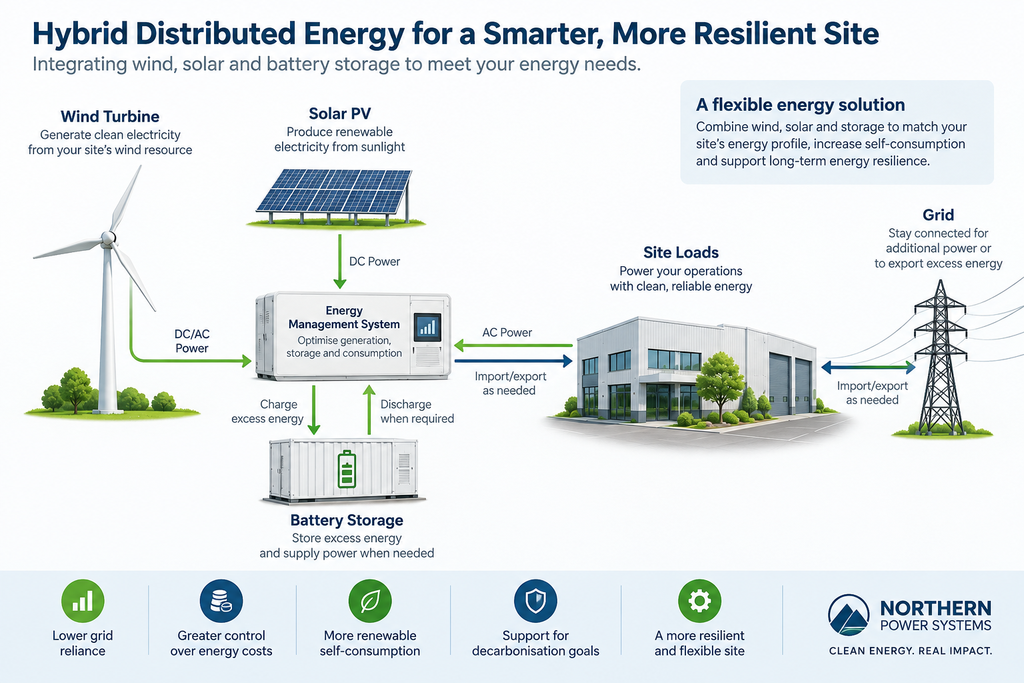
Distributed energy does not require choosing between wind, solar and storage.
For some sites, combining technologies can create a more flexible generation profile.
Wind and solar resources can complement one another depending on local conditions and seasonal patterns, while battery storage can help manage the timing between electricity generation and consumption.
A hybrid system may therefore include:
Wind + Solar + Battery Storage + Grid → Site Energy Demand
The optimum configuration depends on the site’s load profile, renewable resources, grid connection and operational priorities.
Can Distributed Energy Improve Energy Resilience?
Potentially, but this requires an important distinction.
Generating electricity on site does not automatically mean that a facility will continue operating during a grid outage. A conventional grid-connected renewable energy system may be required to disconnect when the grid fails.
Maintaining critical loads during an outage generally requires an appropriately engineered system architecture, which may include battery storage, controls, protection equipment and intentional islanding capability where permitted.
Businesses seeking resilience should therefore define which loads must remain operational and incorporate that requirement into the system design from the beginning.
Is On-Site Wind Generation Suitable for Your Business?
Not every site is suitable for a wind turbine.
The strongest candidates generally combine sufficient wind resource, suitable space, meaningful electricity demand and a viable planning and grid-connection pathway.
Before developing an on-site wind generation project, businesses should assess:
- local wind conditions;
- electricity consumption and load profile;
- available land and turbine location;
- planning constraints;
- grid connection and export capacity;
- expected renewable self-consumption;
- project economics and financing.
This assessment provides a much stronger basis for investment than selecting equipment first and assessing the site afterwards.
Building a Distributed Energy Strategy
The UK energy system is becoming increasingly decentralised and flexible, with distributed generation, storage and demand-side resources playing a larger role.
For individual businesses, however, the opportunity is highly site-specific.
The most effective distributed energy strategy starts with understanding the facility: how much electricity it consumes, when it consumes it, what renewable resources are available and what technical or grid constraints must be addressed.
For locations with suitable wind conditions, distributed wind energy can become an important part of that strategy, either as a standalone generation asset or alongside solar, battery storage and the grid.
Northern Power Systems can support organisations evaluating whether distributed wind is appropriate for their site.
Considering on-site wind generation in the UK?
Request a site and energy assessment to discuss your electricity demand, wind resource and potential project configuration.
FAQ
What is distributed energy?
Distributed energy is electricity generation or energy resources located close to the point where energy is consumed. Examples can include on-site wind turbines, solar PV, battery storage and other Distributed Energy Resources.
Is on-site wind energy suitable for every UK business?
No. Wind projects depend on the quality of the wind resource, available space, electricity demand, planning requirements, grid connection and project economics. A feasibility assessment is necessary before determining whether a site is suitable.
Can wind turbines be combined with solar and battery storage?
Yes. Wind, solar and battery storage can be integrated within hybrid energy systems where the site’s technical and economic requirements support that configuration.
What happens when there is not enough wind?
A grid-connected site can draw electricity from the grid when wind generation is insufficient. In hybrid systems, other generation sources or stored energy may also contribute depending on the system design.
Will an on-site wind turbine keep my business operating during a power cut?
Not necessarily. Standard grid-connected generation may disconnect during an outage. Backup operation requires an appropriately designed system with the necessary controls, protection and potentially battery storage or other generation.
What grid connection requirements apply to distributed generation in the UK?
Requirements depend on the project and connection characteristics. Projects operating in parallel with the distribution network may need to comply with applicable UK connection requirements such as G99 and work with the relevant Distribution Network Operator.
How do I start a distributed wind project?
Start with a site and energy assessment. Wind conditions, electricity consumption, turbine siting, planning, grid connection and expected self-consumption should be evaluated before the final system configuration is selected.