
Clean energy incentives in Nova Scotia are creating new opportunities for businesses evaluating on-site renewable energy. Combined with federal clean technology tax credits, these measures can reduce eligible upfront investment costs and improve the economics of projects such as commercial wind energy.
For businesses with significant electricity demand and a suitable wind resource, the opportunity goes beyond sustainability. On-site generation can become part of a long-term strategy to reduce exposure to electricity costs, diversify energy supply and invest in productive energy infrastructure.
However, incentives are only one part of the equation. The actual business case depends on project eligibility, wind resource, electricity consumption, installation costs, grid requirements and long-term energy production.

Clean Energy Incentives in Nova Scotia: What Businesses Should Know
Canadian businesses investing in renewable energy may have access to federal tax incentives as well as regional programs, depending on the project and applicant.
One of the most relevant measures is Canada’s Clean Technology Investment Tax Credit (ITC).
Under current federal rules, eligible clean technology property can qualify for a refundable tax credit. Wind energy systems are among the electricity generation technologies included within the program.
The regular Clean Technology ITC rate can reach 30% for eligible property, subject to the applicable requirements and conditions. Businesses should confirm eligibility, qualifying expenditures and labour requirements with qualified tax and financial advisers before including the credit in project economics.
Regional support may also be available through programs administered by organizations such as the Atlantic Canada Opportunities Agency (ACOA). Eligibility and funding vary by program and project, so potential support should be assessed individually rather than assumed as part of every wind energy investment.
3 Business Benefits of Investing in On-Site Wind Energy
Clean energy incentives can reduce the initial financial barrier, but the long-term value of a commercial wind project depends primarily on how well the technology matches the site and its energy needs.
1. Reduce Eligible Upfront Investment Costs
For eligible projects, the Clean Technology Investment Tax Credit can significantly affect initial project economics.
This matters because capital expenditure is one of the main barriers businesses face when evaluating on-site renewable generation. Reducing eligible net investment costs can make projects that previously appeared difficult to justify more attractive for further feasibility analysis.
The final financial benefit, however, depends on the specific project, tax position and eligibility requirements.
2. Generate Renewable Electricity Close to the Point of Use
Distributed wind energy generates electricity at or near the location where it is needed.
For commercial, industrial and agricultural organizations with suitable wind conditions, on-site generation can supply part of the site’s electricity demand and reduce the amount of electricity that needs to be purchased externally.
The value of that electricity depends on factors including the site’s tariff, load profile, wind resource and the amount of generated energy that can be effectively used on site.
3. Build a Longer-Term Energy Strategy
A commercial wind turbine is a long-term infrastructure investment rather than a short-term energy purchase.
When properly designed for the site, distributed generation can help businesses diversify their energy sources and reduce part of their exposure to future electricity-cost changes.
This is particularly relevant in Nova Scotia, where electricity tariffs and business energy costs continue to evolve. A project-specific analysis can compare expected wind generation against actual electricity consumption and tariffs to determine whether on-site wind makes financial sense.
How the Clean Technology Investment Tax Credit Applies to Wind Energy
The federal Clean Technology Investment Tax Credit includes eligible electricity generation equipment using renewable sources such as wind.
Under the current framework, qualifying clean technology property acquired and available for use within the applicable period may benefit from a refundable tax credit.
The regular credit rate is currently up to 30% for qualifying property available for use before 2034, subject to applicable conditions. Labour requirements can affect the available credit rate, so businesses should not assume that every project automatically receives the maximum percentage.
Before developing a financial model, project owners should therefore verify:
- whether the business and equipment qualify;
- which project expenditures are eligible;
- when the equipment must be acquired and available for use;
- which labour requirements apply;
- whether other federal or regional support can be combined with the tax credit.
Tax incentives should always be confirmed with qualified professional advisers before an investment decision is made.
A Real Commercial Wind Project in Nova Scotia
Nova Scotia already provides a practical example of how distributed wind can be integrated into a commercial property.
At the Atlantic Superstore in Porters Lake, an NPS 100-21 wind turbine was installed to generate renewable electricity close to where it would be consumed.
Based on the documented project assumptions and an average wind speed of 6.6 m/s (14.8 mph), the turbine was projected to generate approximately 250,000 kWh per year and meet around 25% of the supermarket’s electrical needs.

The site’s major electricity loads included HVAC and refrigeration, making it an example of how distributed wind can support an energy-intensive commercial facility.
The project does not mean that every commercial site in Nova Scotia will achieve the same production or economics. Wind resource, electricity consumption, turbine configuration and site conditions must be evaluated individually.
Is Commercial Wind Energy Suitable for Every Business?
No. Clean energy incentives can improve project economics, but they cannot make an unsuitable wind site suitable.
A commercial wind energy project should normally be evaluated against several factors:
- Wind resource: expected energy production depends heavily on local wind conditions.
- Electricity demand: businesses with significant and consistent consumption may have greater opportunities to use generation on site.
- Load profile: when and how electricity is consumed affects the value of self-generated energy.
- Site characteristics: available space, access, terrain and surrounding infrastructure influence project feasibility.
- Grid connection: interconnection requirements must be assessed for each project.
- Permitting: applicable local and provincial requirements need to be considered.
- Project economics: capital expenditure, operating costs, incentives, expected generation and electricity value must be analysed together.
This is why a site-specific feasibility assessment is more useful than relying on a generic payback estimate.
From Incentives to Project Economics
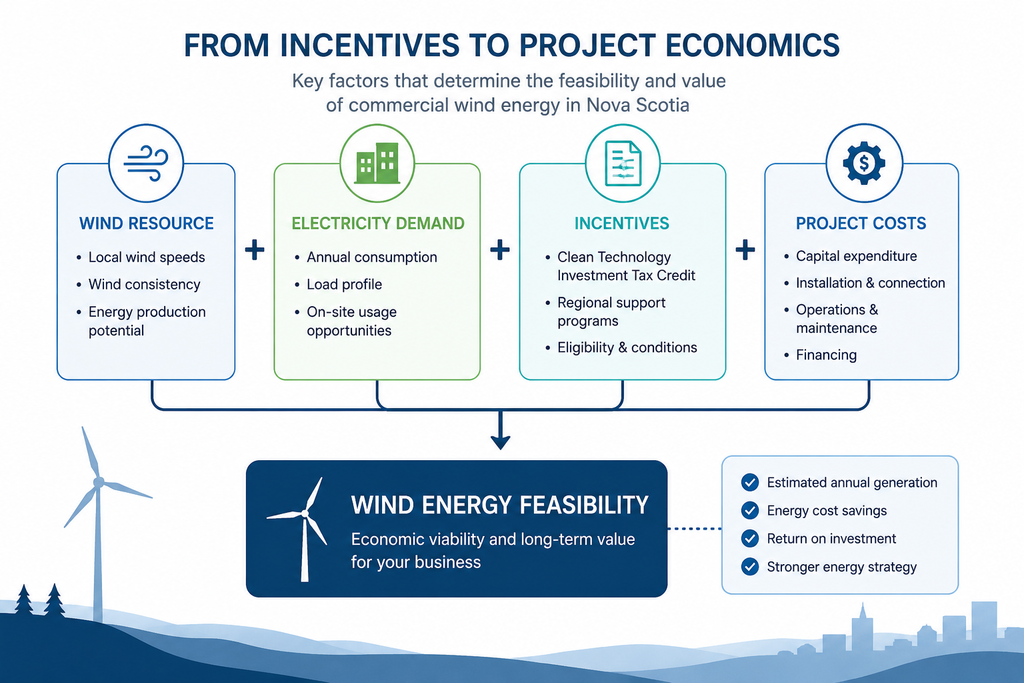
The most important question for a business is not simply “What incentive can I receive?”
It is:
“What will this project produce, what will it cost after eligible incentives, and what value will that electricity create for my business?”
A robust assessment combines wind-resource data, electricity consumption, applicable tariffs, project costs and confirmed incentive eligibility.
Only then is it possible to estimate expected annual generation, energy savings and potential return on investment with meaningful accuracy.
Evaluate Your Wind Energy Opportunity in Nova Scotia
Clean energy incentives in Nova Scotia and Canada’s federal Clean Technology Investment Tax Credit can make the current environment worth evaluating for businesses considering renewable energy investment.
But incentives should support a technically and economically sound project—not replace proper feasibility analysis.
Northern Power Systems develops distributed wind solutions for commercial, industrial, agricultural and institutional applications. Our team can help evaluate the wind resource, energy demand and technical requirements of a potential project.
If your organization is considering on-site wind generation in Nova Scotia, the first step is to determine whether your site and energy profile support a viable project.
Contact Northern Power Systems to discuss your site and evaluate the potential for commercial wind energy.