
In recent years, energy markets have become increasingly volatile, exposing companies around the world to siFor remote sites, islands and businesses that depend on diesel power generation, energy costs are influenced by more than the price of electricity. Fuel transportation, storage, generator operation and exposure to fuel-price volatility can all affect the long-term cost and resilience of the energy system.
For this reason, businesses are increasingly evaluating diesel generation alternatives that can reduce fuel consumption without compromising reliable power supply.
Wind energy, solar PV, battery storage and hybrid microgrids can all play a role. The right solution, however, depends on the site’s renewable resources, load profile, existing infrastructure and reliability requirements.

Why Businesses Are Looking for Diesel Generation Alternatives
Diesel generators remain valuable because they provide dispatchable power and can support critical loads. But relying on diesel as the primary source of electricity creates several potential challenges, particularly for remote and off-grid operations.
These include:
- exposure to fuel-price volatility;
- fuel transportation and storage costs;
- dependence on supply chains;
- generator operating and maintenance requirements;
- emissions associated with fossil-fuel consumption.
When evaluating diesel generation alternatives, the objective is not necessarily to eliminate diesel generation immediately. In many applications, a more practical objective is to reduce diesel fuel consumption and generator runtime by integrating locally available renewable energy.
For sites with suitable resources, this can transform diesel from the primary energy source into a backup or balancing resource.
What Are the Main Diesel Generation Alternatives?
There is no single technology that can replace diesel generation in every application. Different technologies solve different parts of the energy challenge.
1. Wind Energy
Wind power can be particularly valuable at locations with a strong and consistent wind resource.
Once installed, a wind turbine generates electricity without consuming fuel. This reduces the amount of electricity that must be produced by diesel generators and therefore limits exposure to fuel-price fluctuations and fuel logistics.
Wind also has a different generation profile from solar PV and can produce electricity during both daytime and nighttime hours.
For remote sites, islands, industrial operations and communities with suitable wind conditions, distributed wind can therefore become an important component of a diesel-reduction strategy.
2. Solar PV
Solar PV is another widely used form of on-site renewable generation.
At locations with strong solar resources and daytime electricity demand, PV can reduce the load that would otherwise be supplied by diesel generators.
Its main limitation in an off-grid application is that generation depends on sunlight. Additional generation, storage or backup capacity is therefore required when electricity must remain available outside solar production hours.
3. Battery Energy Storage
Battery energy storage does not generate electricity, but it can significantly change how renewable energy and diesel generators interact.
A battery can store excess renewable electricity and release it when required, help manage short-term variations between generation and demand, and potentially reduce unnecessary generator operation.
The appropriate battery capacity and operating strategy depend on the site’s load profile, renewable generation and required level of resilience.
4. Wind and Solar Hybrid Systems
Combining wind and solar can create a more diversified renewable generation profile.
Solar generation is concentrated during daylight hours, while wind production depends on local meteorological conditions and may continue overnight or during periods of low solar output.
Where the resources are complementary, combining the two can increase the share of site demand supplied by renewable electricity.
NPS develops wind solar hybrid systems that can combine wind, solar PV, battery storage and backup generation.
5. Renewable Microgrids with Diesel Backup
For many remote or mission-critical applications, the most practical alternative to diesel-only generation is not a single technology but an integrated wind microgrid solution.
A wind diesel hybrid system, for example, can combine wind generation with existing diesel generators. More advanced configurations can integrate wind, solar PV, battery storage and intelligent controls.
In this configuration, renewable resources supply electricity whenever conditions allow, while storage and backup generation help maintain the required balance between electricity supply and demand.
This approach can reduce diesel consumption while retaining dispatchable generation for periods when renewable production is insufficient.
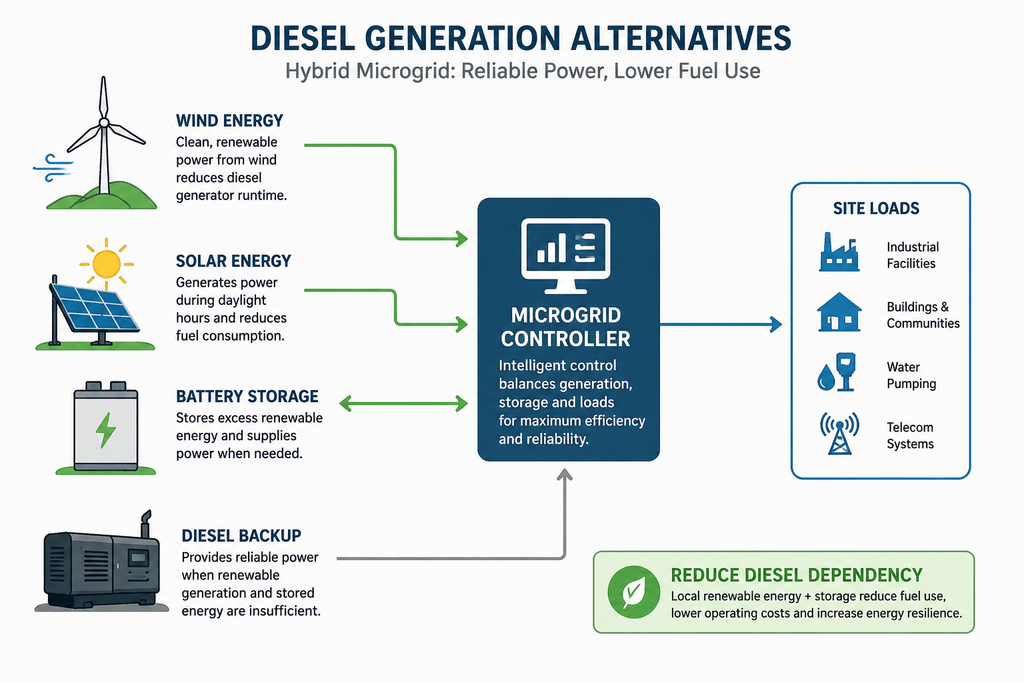
How Wind Energy Can Reduce Diesel Fuel Consumption
Among the available diesel generation alternatives, wind energy is particularly relevant where diesel fuel is expensive to transport and the local wind resource is strong.
A practical example is the NPS hybrid renewable energy project on Necker Island, where wind turbines operate as part of an off-grid energy system designed to reduce dependence on imported diesel fuel.
The principle is straightforward: every unit of usable electricity generated locally from wind can reduce the amount of electricity that needs to be generated from diesel, subject to system operating constraints.
Real-world projects demonstrate this approach.
The U.S. Department of Energy has documented remote Alaskan communities using wind-diesel systems specifically to reduce fossil-fuel consumption. Distributed wind projects in remote communities have also demonstrated the ability of locally generated wind power to offset diesel use and associated fuel costs.
Actual fuel savings, however, should never be assumed from a generic percentage. They depend on factors including:
- wind resource;
- turbine capacity;
- site electricity demand;
- existing generator configuration;
- renewable penetration;
- energy storage;
- system controls and dispatch strategy.
A project-specific energy assessment is therefore essential.
When Does a Wind-Diesel Hybrid System Make Sense?
A wind-diesel hybrid system can be particularly attractive when several conditions occur together.
The site has a suitable wind resource. Electricity demand is significant and relatively consistent. Diesel fuel represents an important operating expense. Fuel delivery is costly or logistically difficult. Reliable electricity remains essential, making immediate elimination of dispatchable generation impractical.
Typical applications can include:
- islands;
- remote communities;
- industrial sites;
- agricultural operations;
- mining and resource operations;
- weak-grid or off-grid facilities.
However, wind is not automatically the best diesel generation alternative for every site.
Poor wind resources, restrictive permitting conditions, unsuitable land availability or a load profile that does not align with expected production can change the economics significantly.
The correct solution must therefore begin with the site rather than the technology.
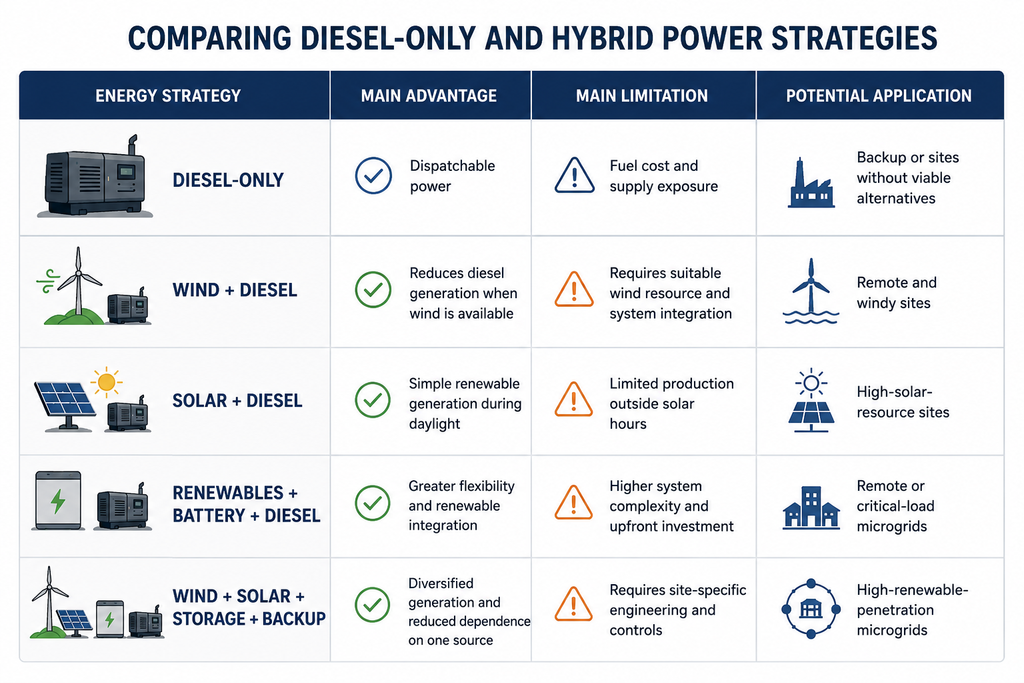
When comparing diesel generation alternatives, the best configuration should be determined by the performance and economics of the total energy system rather than by the cost of an individual component.
Evaluate the Total Cost of Diesel Generation
When comparing diesel generation alternatives, businesses should avoid looking only at the purchase price of a generator or renewable energy asset.
A more useful way to compare diesel generation alternatives is to consider the long-term cost of delivering electricity.
Depending on the project, this may include:
- diesel purchase price;
- fuel transportation;
- fuel storage and handling;
- generator maintenance;
- expected generator runtime;
- renewable energy production;
- battery replacement assumptions;
- financing and capital expenditure;
- system lifetime;
- operational requirements.
This lifecycle perspective makes it possible to determine whether adding renewable generation can create economic value over the expected project life.
Northern Power Systems and Hybrid Energy Applications
Northern Power Systems has more than 40 years of experience in wind technology and has deployed turbines in a range of distributed energy applications around the world.
Among the available diesel generation alternatives, NPS wind turbines can be integrated with solar PV, battery storage and backup generation as part of hybrid energy systems designed around site-specific energy requirements.
For remote and off-grid projects, the objective is not simply to add renewable capacity. Generation, demand, storage, backup power and system controls need to operate as one energy system.
This is particularly important when reducing diesel dependency while maintaining the level of reliability required by the site.
From Diesel Dependency to a Site-Specific Energy Strategy
There is no universal solution among the available diesel generation alternatives.
For some sites, solar PV may provide the strongest economics. For others, a strong wind resource can make distributed wind particularly valuable. Where continuous and resilient power is essential, combining renewable generation, battery storage and dispatchable backup in a microgrid may offer the most appropriate solution.
Choosing between diesel generation alternatives therefore starts with understanding the site’s energy demand, existing generation, renewable resources and cost of diesel power.
If your business operates a remote, off-grid or diesel-dependent site, Northern Power Systems can help evaluate whether wind energy or an integrated hybrid system is appropriate for your project.