
As farms become increasingly energy-intensive, agricultural businesses are looking for ways to control electricity costs, strengthen energy resilience and reduce their dependence on conventional power sources. Wind energy for farms can provide part of the answer by generating renewable electricity close to where it is consumed.
Irrigation pumps, ventilation systems, milking equipment, refrigeration, cold storage and processing facilities can all create substantial electrical loads. Where the wind resource, site conditions, grid connection and energy demand are suitable, on-site wind power can offset part of this consumption and support a broader agricultural energy strategy.
However, not every farm is automatically a good candidate for wind energy. A successful project begins with understanding the site’s wind resource, electricity demand, available land, grid infrastructure and project economics.
Learn more about NPS wind turbines for agriculture and their applications in modern farming operations.
Why Wind Energy for Farms Is Becoming More Important
Modern agriculture depends on reliable energy.
Electricity may be required for irrigation, heating and ventilation, refrigeration, milking, feeding systems, grain handling and on-site processing. For energy-intensive agricultural businesses, this makes energy supply and cost an important operational consideration.
Wind energy for farms provides an opportunity to generate electricity directly at or near the point of use. This approach is a form of distributed wind energy: rather than generating electricity exclusively at a large remote wind farm, distributed wind systems serve local energy demand or connect at the distribution level of the electricity network.
For farms with an appropriate wind resource and load profile, this can reduce electricity purchased from the grid while increasing the share of energy generated on-site.
7 Benefits of Wind Energy for Farms
1. Offset Electricity Used by Farm Operations
One of the main reasons to evaluate a farm wind turbine is the opportunity to offset electricity that would otherwise be purchased from the grid.
The value of the electricity generated depends on factors including the farm’s consumption profile, wind resource, electricity tariff, export arrangements and applicable regulations. High on-site consumption can make locally generated electricity particularly relevant because more of the energy can potentially be used directly by the operation.
2. Power Energy-Intensive Agricultural Loads
Wind generation can contribute electricity for a wide range of agricultural applications, including:
- irrigation and water pumping;
- milking parlours and dairy equipment;
- ventilation and climate-control systems;
- refrigeration and cold storage;
- lighting and automated feeding systems;
- grain handling and storage;
- on-site processing equipment.
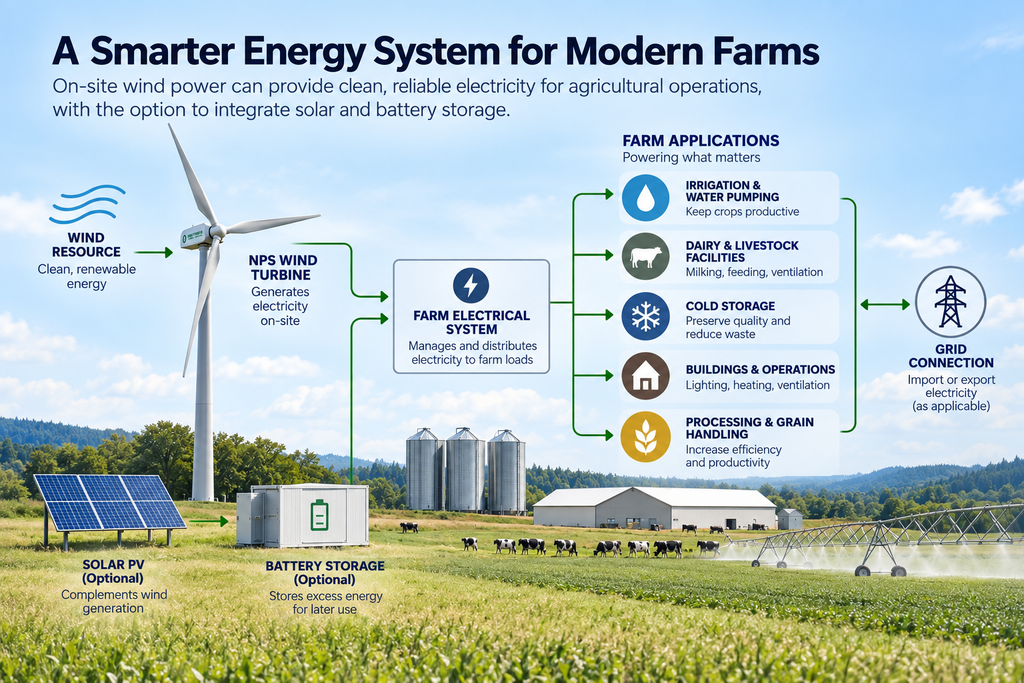
The suitability of wind for each application depends on when electricity is consumed and when the turbine produces energy. Matching generation with the farm’s load profile should therefore form part of the project assessment.
3. Reduce Dependence on Grid Electricity
Generating electricity on-site can reduce the amount of power a farm needs to purchase from the grid.
This does not mean that a grid-connected wind turbine automatically provides backup power during an outage. If resilience during grid failures is required, the overall electrical system must be designed accordingly and may involve battery storage, suitable controls, other generation sources and microgrid capabilities.
4. Make Productive Use of Agricultural Land
Wind generation and agricultural production do not necessarily compete for the same land.
The U.S. Department of Energy notes that crops can be grown close to wind turbine bases and livestock can continue grazing around turbines. This allows suitable farms to combine electricity generation with their existing agricultural activity.
5. Support Sustainability and Decarbonisation Goals
Generating renewable electricity on-site can help agricultural businesses reduce the emissions associated with purchased electricity, depending on the local electricity mix and how the project operates.
For farms supplying retailers, food processors or other businesses with sustainability targets, renewable energy generation may also contribute to wider environmental and supply-chain objectives.
Any emissions reduction or ESG claim should be calculated using an appropriate methodology rather than assumed from turbine capacity alone.
6. Integrate Wind With Other Energy Technologies
A farm’s energy strategy does not need to rely on a single renewable technology.
Depending on the site, wind energy for agriculture can be combined with solar PV, battery energy storage, controllable generation and energy management systems. Because wind and solar production profiles can differ, a hybrid approach may provide a more diversified source of on-site renewable generation.
The optimal configuration is site-specific and should be based on measured or modelled generation, load requirements and the required level of resilience.
7. Create Long-Term Value From a Suitable Wind Resource
For farms located in areas with a strong and commercially viable wind resource, a turbine can turn that natural resource into productive energy infrastructure.
The business case depends on more than turbine capacity. Annual energy production, capital and operating costs, electricity prices, self-consumption, export compensation, financing, permitting and grid-connection requirements all affect project economics.
For this reason, realistic energy-yield and financial modelling should precede any investment decision.
Is a Wind Turbine Suitable for Your Farm?
Wind energy for farms is most attractive when the site’s technical and commercial conditions work together.
Before developing a project, several questions should be answered:
- What is the wind resource at the proposed turbine location and hub height?
- How much electricity does the farm consume, and when?
- How much generated electricity could be consumed on-site?
- Is there enough suitable land for the turbine, access and required setbacks?
- What grid connection is available?
- Can surplus electricity be exported, and under what commercial terms?
- What planning, environmental and permitting requirements apply?
- Would solar PV, battery storage or a hybrid system improve the project?
A site-specific assessment is therefore more useful than relying on generic estimates of turbine output or payback.
Wind Energy for Agriculture in Practice: NPS Farm Projects
Northern Power Systems has supplied wind turbines to agricultural operations with very different energy requirements.
At Newington Farm in Scotland, an NPS 100-21 was selected to support an intensive potato farming operation with significant cold-storage demand. According to the NPS project case study, the turbine generated 150,000 kWh during its first nine months of operation at a site with an averagec wind speed of 6 m/s.
At Blue Spruce Farm in Vermont, an NPS100-24 became part of a wider renewable energy strategy combining wind generation and biogas. The dairy farm’s major electrical loads include its milking parlour and barn ventilation systems.
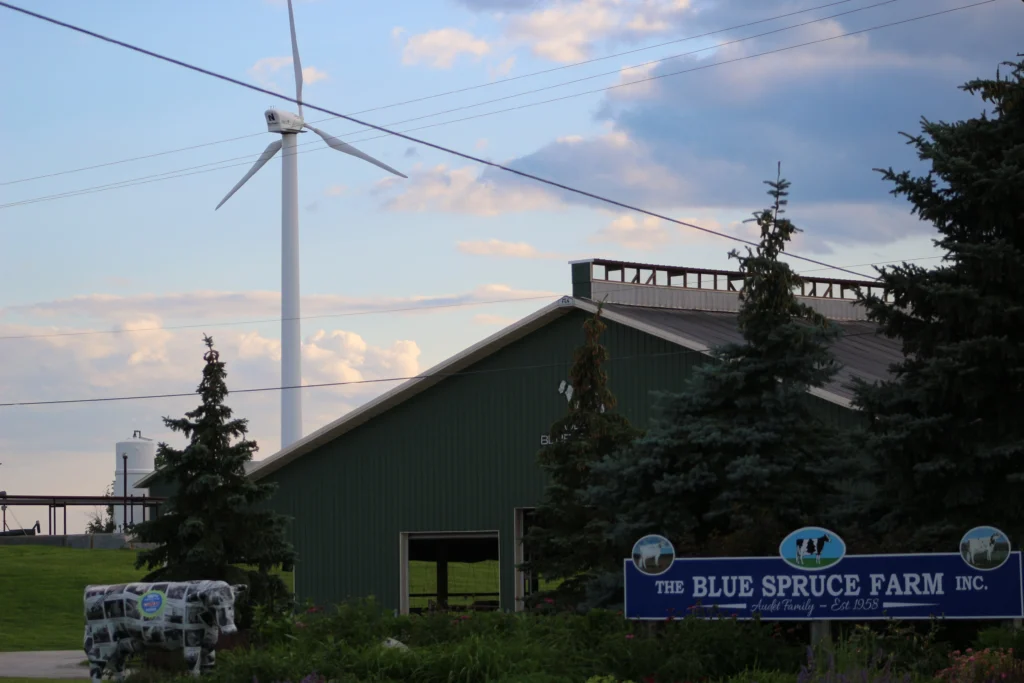
These projects illustrate an important point: the value of wind energy for farms depends on matching the technology to the site’s wind conditions, electrical infrastructure and agricultural energy requirements.
From Wind Resource to a Viable Farm Energy Project
Successful wind energy for farms projects begin with the site, not the turbine.
Wind resource assessment helps estimate potential energy production. The farm’s electricity data can then be analysed to understand how generation aligns with consumption. Grid connection, planning constraints, access, foundations and project economics must also be evaluated before a final system configuration is selected.
This process allows farm owners and project developers to move from a general interest in renewable energy to a technically and commercially grounded investment decision.
Why Northern Power Systems for Agricultural Wind Energy?
Northern Power Systems has decades of experience in distributed wind technology and has supplied turbines for agricultural, commercial, industrial, institutional and remote applications.
For agricultural projects, the objective is not simply to install a turbine. It is to determine whether on-site wind power fits the site’s resource, energy demand and wider operational objectives.
For farms considering wind generation, the next step should therefore be a site-specific evaluation rather than a generic estimate.
Considering wind energy for your farm? Explore our wind turbine solutions for agriculture or contact Northern Power Systems to discuss your site’s wind resource, electricity demand and project requirements.