
A hurricane proof wind turbine must combine reliable energy generation with engineering designed for safe operation when weather conditions become extreme. Recent severe weather in Sardinia has provided a real-world example of why wind turbine resilience matters for developers, owners and investors.
More than 100 Northern Power Systems wind turbines are installed across Sardinia. During recent adverse weather conditions, the turbines continued operating steadily up to their defined cut-out wind speed, while remaining within their safety parameters.
Their performance provides a useful example of how wind turbine engineering, control systems and protection strategies contribute to reliable operation in challenging environments.

Extreme Rainfall and Severe Weather in Sardinia
Recent waves of severe weather affecting Sardinia have brought the resilience of energy infrastructure back intExtreme precipitation is becoming more frequent in parts of Italy.
A 2026 study published in Natural Hazards and Earth System Sciences, led by researchers from the University of Milan with contributions from CNR, the Norwegian Meteorological Institute and Ricerca sul Sistema Energetico, analysed extreme hourly precipitation patterns across Italy between 1986 and 2022.
The researchers identified significant increasing trends in extreme precipitation events across several areas and seasons, including parts of Sardinia’s eastern coast during autumn. [EXTERNAL LINK TO ADD: Natural Hazards and Earth System Sciences study]
These short but intense events can place significant pressure on waterways, slopes, drainage systems and infrastructure. For energy developers and asset owners, changing weather patterns also reinforce the importance of considering environmental exposure when selecting and designing renewable energy systems.
What Does Severe Weather Mean for a Wind Turbine?
IWind turbines operate in continuously changing atmospheric conditions, but severe weather can expose the entire system to more demanding loads.
Understanding wind turbine extreme weather performance requires looking at both structural loads and the turbine’s control and protection systems.
Depending on the site and weather event, adverse conditions may involve:
- increased turbulence;
- sudden and intense wind gusts;
- higher structural loads on the tower, nacelle and blades;
- heavy precipitation;
- operating conditions approaching the turbine’s defined safety limits.
For this reason, wind turbine resilience depends on more than structural strength alone. Turbine controls, protection strategies and the ability to respond safely as wind conditions change are also critical.
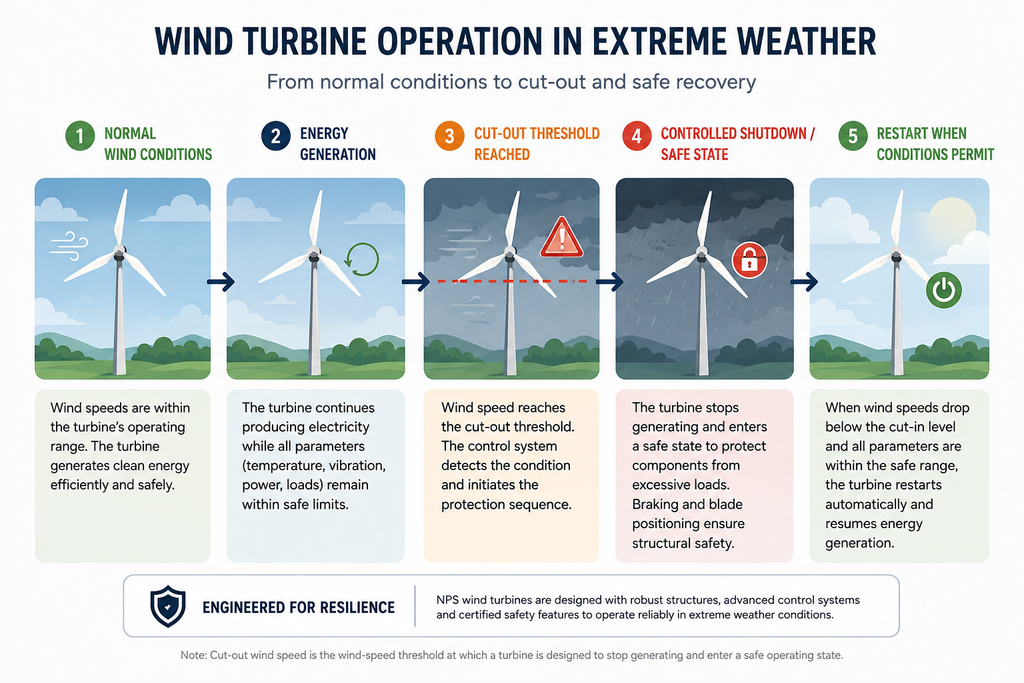
One of the most important parameters is the cut-out wind speed.
What Is Cut-Out Wind Speed?
Cut-out wind speed is the wind-speed threshold at which a turbine is designed to stop generating and enter a safe operating state to protect its components from excessive loads.
A turbine therefore does not need to continue generating electricity regardless of wind speed to demonstrate resilience.
Instead, reliable extreme-weather performance means generating energy efficiently while conditions remain within the permitted operating envelope and responding appropriately when safety thresholds are reached.
This distinction is particularly important when evaluating a wind turbine in extreme weather.
100+ NPS Wind Turbines Operating in Sardinia
During recent severe weather in Sardinia, more than 100 Northern Power Systems wind turbines installed across the island continued to operate steadily and efficiently up to their cut-out wind speed, while remaining within the turbines’ safety parameters. [NPS TO CONFIRM: operational evidence and exact event/date]
In practical terms, this means the turbines were able to:
- continue producing energy while wind conditions remained within their permitted operating range;
- activate protection strategies when required;
- respond to changing wind conditions according to their control and safety logic.
The event provides useful field evidence of turbine behaviour in a demanding operating environment.
For project developers and asset owners, this type of real-world operating experience is particularly valuable. Wind turbine selection is not simply a question of rated power or expected annual energy production: reliability, control strategy, environmental conditions and long-term operation must also be considered.
Hurricane Proof Wind Turbine Engineering for Extreme Conditions
Northern Power Systems develops wind turbines for operation in demanding environments, including sites exposed to severe wind conditions.
NPS 100 wind turbines have been deployed not only in Sardinia but also in Caribbean locations where tropical storms and hurricanes are a fundamental consideration in project design.
However, the term “hurricane proof wind turbine” should not be interpreted as meaning that a turbine can operate normally through every hurricane regardless of wind speed or site conditions.
Extreme-weather resilience depends on the complete project configuration, including turbine design, control and protection systems, tower and foundation engineering, site characteristics and the expected extreme wind conditions.
For this reason, each wind project requires a site-specific technical assessment.
Why Wind Turbine Resilience Matters to Project Owners
Severe-weather resilience has direct implications for the long-term technical and financial performance of a wind project.
A turbine designed and selected appropriately for its operating environment can help project owners pursue:
- reliable renewable energy generation;
- controlled turbine response during severe wind conditions;
- protection of critical turbine components;
- reduced exposure to avoidable downtime;
- long-term asset performance.
These considerations become particularly important for projects in exposed coastal areas, islands and remote locations, where maintenance logistics can be more complex and energy reliability may have greater operational value.
The objective is not simply to withstand one extreme event. It is to design an energy asset capable of delivering reliable performance over its operational life under the environmental conditions expected at that specific site.
Field Performance as a Test of Engineering Quality
Severe weather provides a real-world test for renewable energy infrastructure.
The recent performance of more than 100 NPS wind turbines in Sardinia demonstrates the importance of combining energy production with appropriate control and protection strategies.

For developers, EPCs and investors considering wind projects in challenging environments, extreme-weather resilience should therefore be evaluated alongside energy yield, installation requirements, maintenance strategy and lifecycle performance.
Northern Power Systems combines wind turbine technology with project-specific engineering to address the operating conditions of each site.
Planning a wind energy project in an exposed, remote or severe-weather location? Contact Northern Power Systems to discuss the wind resource, environmental conditions and technical requirements of your project.