
An aging wind turbine does not always need to be decommissioned. The IBEW Electrical Industry Training Center in Boston demonstrates how a wind turbine repowering project can transform an unsupported turbine into a modern, reliable, and high-performing renewable energy asset.
By combining the NPS100C platform with a customized engineering solution, Northern Power Systems was able to reuse key existing infrastructure, complete the repowering in approximately one week, and restore the site to reliable energy production.
The Challenge: An Orphan Wind Turbine
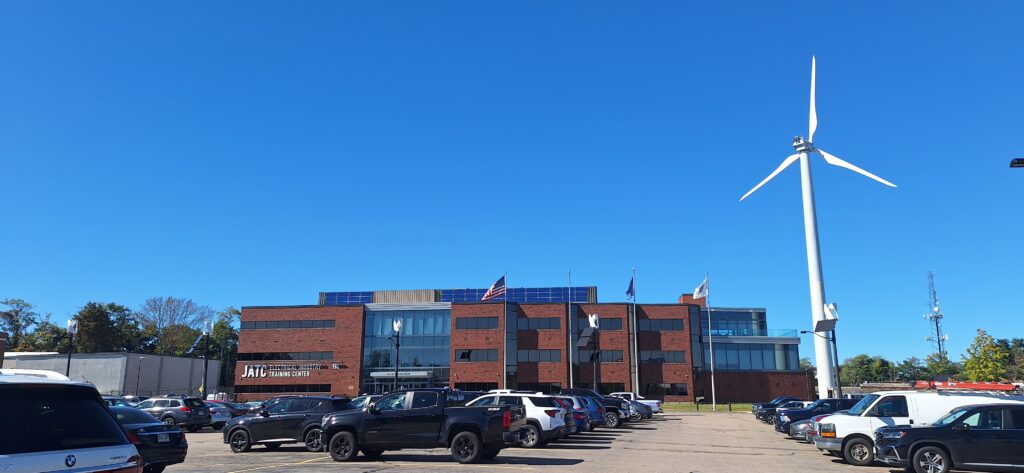
The project was carried out at the International Brotherhood of Electrical Workers (IBEW) Electrical Industry Training Center in Boston, Massachusetts, in partnership with Lighthouse Electrical Contracting.
The site was originally equipped with a 100 kW Fuhrländer Astos turbine. After the original manufacturer ceased operations, the turbine became an orphan asset, leaving the customer without OEM support and making spare parts and long-term maintenance increasingly challenging.
The turbine was no longer operating, but the site itself still represented a valuable renewable energy asset. Its foundation, tower infrastructure, electrical feeder, and grid connection created an opportunity to restore energy production without developing an entirely new wind project.
Instead of decommissioning the installation, the customer chose a wind turbine repowering project designed to extend the life of the existing site and maximize the value of its original infrastructure.
The Northern Power Systems Solution
Northern Power Systems developed a customized repowering solution based on the NPS100C-24 platform.
Rather than replacing the entire installation, the project was engineered around the infrastructure already available on site. The existing foundation and lower tower section were retained, while Northern Power Systems designed a new custom upper tower section to integrate the NPS100C while maintaining the same overall tip height.
The existing feeder wire was also reused, while the remaining power electronics were replaced with modern equipment.
This approach significantly reduced the need for new site development and civil works, helping lower project complexity, costs, and installation time.
The new NPS100C also introduced modern Permanent Magnet Direct Drive (PMDD) technology with no gearbox, improving long-term reliability and reducing maintenance requirements.
From Old Turbine to NPS100C in One Week
One of the most significant achievements of the Boston wind turbine repowering project was the speed of execution.
From removal of the existing turbine to replacement and commissioning of the new NPS100C, the entire process was completed in approximately one week.
By reusing existing infrastructure and minimizing new construction, Northern Power Systems was able to streamline the repowering process while giving the customer a modern turbine platform designed for long-term operation and serviceability.
The result was not simply the replacement of an old turbine, but the transformation of an unsupported wind asset into a productive renewable energy system once again.
Repowering Performance: Exceeding Expectations
The benefits of the repowering became clear during the first months of operation.
Between October 2025 and May 2026, the NPS100C generated 96,971 kWh, compared with an expected production of 91,332 kWh.
The turbine achieved:
- 96,971 kWh total energy production
- 106.2% Performance Factor
- 99.9% Operational Availability
- 4.35 m/s average wind speed
Monthly performance was particularly strong. The turbine met or exceeded expected production throughout almost the entire reporting period, with monthly Performance Factors reaching 118% in April 2026 and 113% in May 2026.
These results demonstrate that repowering did more than simply restore the site’s ability to generate electricity. It provided the customer with a modern wind turbine capable of delivering high availability and energy performance above expectations.
The Benefits of the IBEW Wind Turbine Repowering Project
The Boston project demonstrates how repowering can provide an attractive alternative to completely decommissioning and rebuilding an aging wind installation.
By integrating new turbine technology with existing infrastructure, the project delivered several important advantages:
- Reuse of the existing foundation and tower infrastructure
- Reduced need for new site development
- Shorter installation and commissioning timeline
- Improved operational reliability
- Lower maintenance requirements
- Modern grid support capabilities
- Extended project lifetime
- Increased energy production through newer turbine technology
The project also upgraded the installation with modern grid capabilities through the UL 1741 SB-certified NPS100C platform, providing improved grid support compared with the previous turbine.

From Orphan Turbine to High-Performing Wind Asset
The IBEW Boston project shows that the end of OEM support does not necessarily mean the end of a wind project’s useful life.
With the right engineering approach, existing foundations, towers, electrical infrastructure, and grid connections can become the starting point for a new generation of energy production.
Northern Power Systems combines flexible engineering with proven Direct Drive technology to develop wind turbine repowering solutions tailored to the specific conditions of each site.
The Boston project is a clear example: an unsupported, non-operational turbine was replaced with a modern NPS100C, the existing infrastructure was preserved wherever possible, installation was completed in approximately one week, and the new turbine achieved 99.9% operational availability and a 106.2% Performance Factor during its first operating period.
Do You Have an Aging or Orphan Wind Turbine?
If your existing wind turbine is no longer supported, has become increasingly expensive to maintain, or is approaching the end of its operational life, repowering may offer an alternative to complete decommissioning.
Contact Northern Power Systems to evaluate your existing wind asset and discover whether a customized repowering solution can extend the life and improve the performance of your project.