
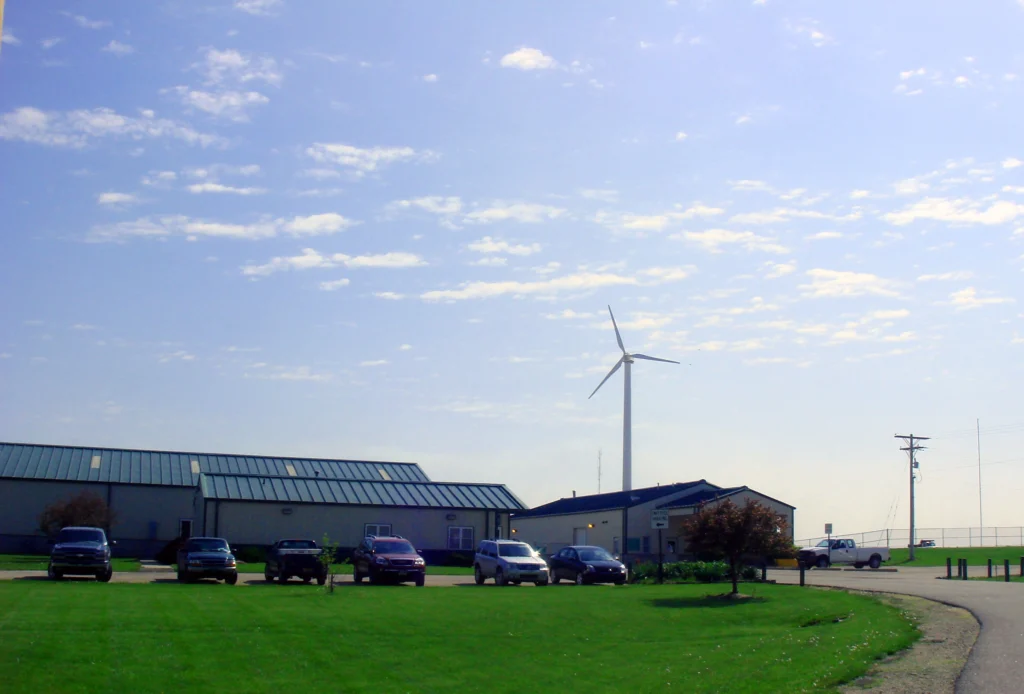
The wind turbine installation at Riley County Public Works demonstrates how public organizations can integrate distributed renewable energy into essential infrastructure. Located in Manhattan, Kansas, the project was developed to serve the Operations & Training Center and the Fleet Maintenance Shop as part of the Resourceful Kansas Program.
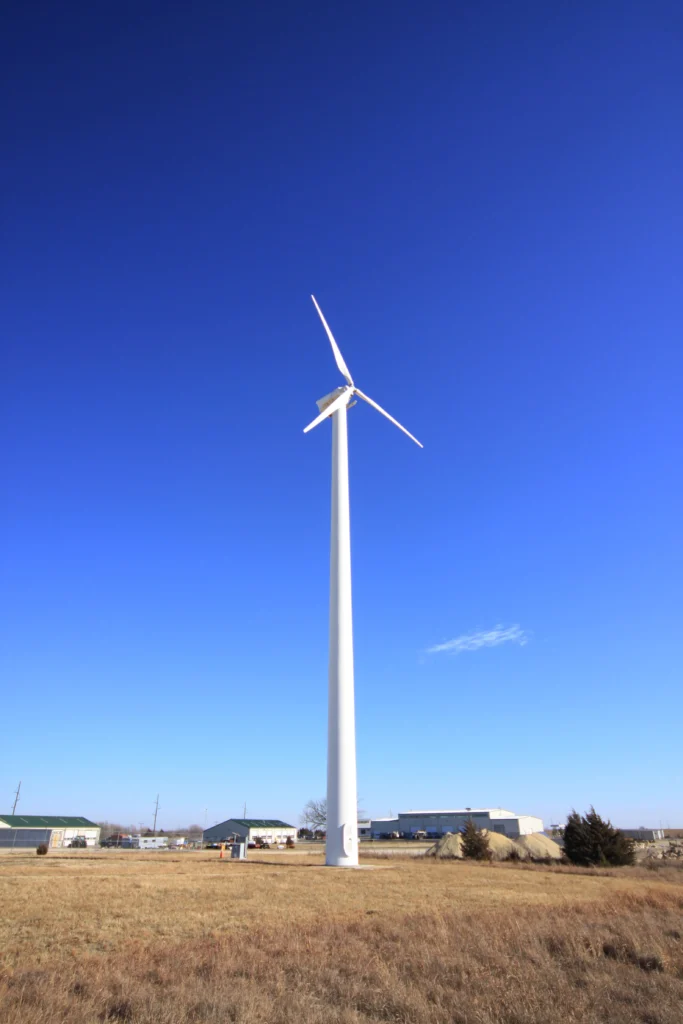
At the center of the wind energy system is a Northern Power Systems NPS 100-21 installed on a 37-meter tower. With an average site wind speed of 6.4 m/s (14.3 mph), the 100 kW direct-drive wind turbine produces approximately 236,000 kWh of renewable electricity annually.
| Location | Manhattan, Kansas, USA |
| Application | Public works facilities |
| Turbine | 1 × NPS 100-21 |
| Tower height | 37 meters |
| Average wind speed | 6.4 m/s (14.3 mph) |
| Annual energy production | 236,000 kWh |
| Annual carbon offset | 177 tons |
| Facilities served | Operations & Training Center and Fleet Maintenance Shop |
| Funding program | U.S. Department of Energy – Energy Efficiency and Conservation Block Grant |
The Resourceful Kansas renewable energy program
Resourceful Kansas was created to help communities across the state transition toward a less energy-intensive and more efficient economy. Riley County received a three-year, $3 million grant from the U.S. Department of Energy to implement the program in partnership with Kansas State University and other project stakeholders.
The initiative followed a three-tiered approach that included a one-day educational seminar, a series of roadshows, energy assessments and follow-up technical assistance. The program engaged more than 280 organizations throughout Kansas, helping communities explore energy efficiency and renewable energy technologies.
The Public Works site included four wind turbines rated at 100 kW, 40 kW, 20 kW and 2.5 kW. Additional technologies included a photovoltaic system, solar hot-water heating, solar-powered street lighting and a waste-oil heater.
The wind turbines were installed to give Resourceful Kansas participants a detailed, real-world view of the benefits and performance of distributed wind energy.
This diversified configuration allowed the project team to evaluate different renewable technologies within the same public infrastructure site.

Riley County wind turbine project
The Riley County wind turbine installation was designed to demonstrate how turbines of different sizes perform in real operating conditions. Performance data could then be compared with measurements collected from an on-site meteorological tower.
Among the four wind turbines installed at the site, the Northern Power Systems NPS 100-21 proved to be the most reliable source within the project’s wind technology portfolio. Its 37-meter tower allowed the turbine to access higher wind speeds and operate more continuously than the smaller machines installed at lower elevations.
“The larger machines operate more continuously because of the higher wind speed at the higher elevation. The Northern Power has a direct-drive, permanent magnet generator which means little maintenance is needed and we’ve had no issues so far. The turbine has exceeded our expectations in the amount of energy produced.”
— Rod Meredith, Former Assistant Director of Public Works
Why the NPS 100-21 was selected
Direct-drive wind turbine technology
The 100 kW wind turbine uses a permanent-magnet direct-drive generator. Unlike conventional geared turbines, the NPS 100-21 does not require a gearbox between the rotor and generator.
Reducing the number of moving mechanical components helps simplify the drivetrain and supports long-term reliability. This configuration is particularly valuable for public organizations seeking predictable operation and manageable maintenance requirements.
At Riley County, this design contributed to minimal maintenance requirements and trouble-free operation during the period described in the original project documentation.
On-site renewable energy generation
Based on the project data, the Riley County NPS 100-21 generates approximately 236,000 kWh of electricity per year and provides an estimated annual carbon offset of 177 tons.
The turbine generates electricity close to the point of consumption. This behind-the-meter approach can help an organization reduce the amount of electricity purchased from the grid while making better use of the wind resource available at its site.
Actual production and economic performance depend on several project-specific factors, including:
- average wind speed;
- turbine siting and tower height;
- local electricity prices;
- permitting and interconnection requirements;
- site energy consumption;
- operations and maintenance costs.
For this reason, projected savings should always be calculated through a site-specific technical and financial assessment.
Performance monitoring
The NPS 100’s SmartView web-based monitoring platform provides access to energy output, estimated carbon emission offsets, cost savings and historical operating data. This transparency allows operators and project stakeholders to evaluate turbine performance through an online interface.
At Riley County, monitoring data also supported the project’s educational and research objectives, helping participants understand the real-world performance of distributed renewable energy technologies.
Wind energy for public infrastructure
The project shows how wind energy for public infrastructure can serve several purposes at the same time.
With an annual energy production of approximately 236,000 kWh and an annual carbon offset of 177 tons, the project provides measurable evidence of the contribution that distributed wind energy can make to public facilities.
A distributed wind turbine can:
- generate renewable electricity at the point of use;
- reduce exposure to changes in grid electricity prices;
- support sustainability objectives with measurable energy and carbon data;
- provide measurable operating data;
- create educational and research opportunities;
- demonstrate clean-energy technologies to the local community.
The broader Resourceful Kansas initiative also examined strategies related to localized electrical distribution and microgrid islanding. This made the Riley County site more than a generation project: it became a platform for evaluating how multiple energy technologies could work together.
Monitoring and lifecycle support
Long-term turbine performance depends on correct siting, professional installation, continuous performance monitoring and planned maintenance.
According to the original project documentation, the Riley County turbine was monitored remotely by Northern Power Systems’ Global Service Center in Vermont. Combined with the NPS 100’s direct-drive design, this monitoring approach helped the operator oversee performance while reducing the need for frequent on-site intervention.
“The Northern Power 100 is a great piece of equipment and has easily been the highlight of our Riley County project. I would recommend the technology to any organization pursuing behind-the-meter wind energy.”
— Jennifer Gunby, Professional Engineer / Project Manager, GBA
A successful public-sector wind turbine installation
The wind turbine installation at Riley County Public Works provides a measurable example of renewable energy applied to public infrastructure. Installed on a 37-meter tower in an average wind resource of 6.4 m/s, the NPS 100-21 produces approximately 236,000 kWh per year and offsets an estimated 177 tons of carbon annually.
By bringing together wind power, solar technologies, energy efficiency and performance monitoring, the Resourceful Kansas project created a valuable demonstration site for public authorities, organizations and communities across the state.
The NPS 100-21 contributed reliable distributed generation while illustrating the advantages of direct-drive technology for behind-the-meter applications.
Planning a wind energy project for a public or institutional site?
Northern Power Systems can support your project from preliminary site assessment and turbine selection to installation, monitoring and long-term service.