
Energy resilience in Puerto Rico has become a critical infrastructure priority. Years of grid instability, extreme weather events and prolonged outages have shown the risks of relying exclusively on centralized electricity infrastructure.
The solution is not simply generating more renewable electricity. Puerto Rico also needs more distributed, resilient and locally controlled energy systems capable of supporting critical loads when the wider grid is disrupted.
For suitable sites, distributed wind energy can contribute to that strategy alongside solar PV, battery storage and microgrids.
Hurricane Maria Changed the Energy Resilience Debate in Puerto Rico
When Puerto Rican artist Bad Bunny performed El Apagón — “The Blackout” — during the Super Bowl halftime show, the message extended far beyond music.
Puerto Rico has experienced persistent problems with electricity reliability, with Hurricane Maria becoming the clearest example of the vulnerability of the island’s electricity infrastructure.
In 2017, Hurricane Maria caused extensive damage to generation, transmission and distribution infrastructure. The resulting blackout became one of the longest in modern U.S. history.
More recently, the U.S. Government Accountability Office reported that significant challenges remain in Puerto Rico’s grid recovery and modernization process.
For businesses, communities and critical infrastructure, these events highlight an important distinction:
Energy resilience is not simply the ability to generate electricity. It is the ability of an energy system to withstand disruption, maintain essential services and recover quickly.

Why Distributed Energy Matters for Puerto Rico
Traditional electricity systems depend heavily on centralized generation and large transmission networks.
When critical infrastructure is damaged, electricity may not reach the sites where it is needed, even if generation capacity remains available elsewhere.
Distributed wind energy and other forms of distributed generation change this model.
Instead of relying entirely on distant power plants, electricity can also be generated closer to the point of consumption through technologies such as:
- wind turbines;
- solar PV;
- battery energy storage;
- distributed generators;
- local microgrids.
This does not mean replacing the electricity grid.
Instead, distributed energy can complement grid modernization by creating additional local generation capacity and reducing dependence on individual centralized assets.
How Puerto Rico Microgrids Can Improve Energy Resilience
A microgrid combines local generation, energy storage, electrical loads and control systems within a defined network.
When appropriately designed for islanded operation, a microgrid can disconnect from the wider grid during an outage and continue supplying selected critical loads using local generation and storage.
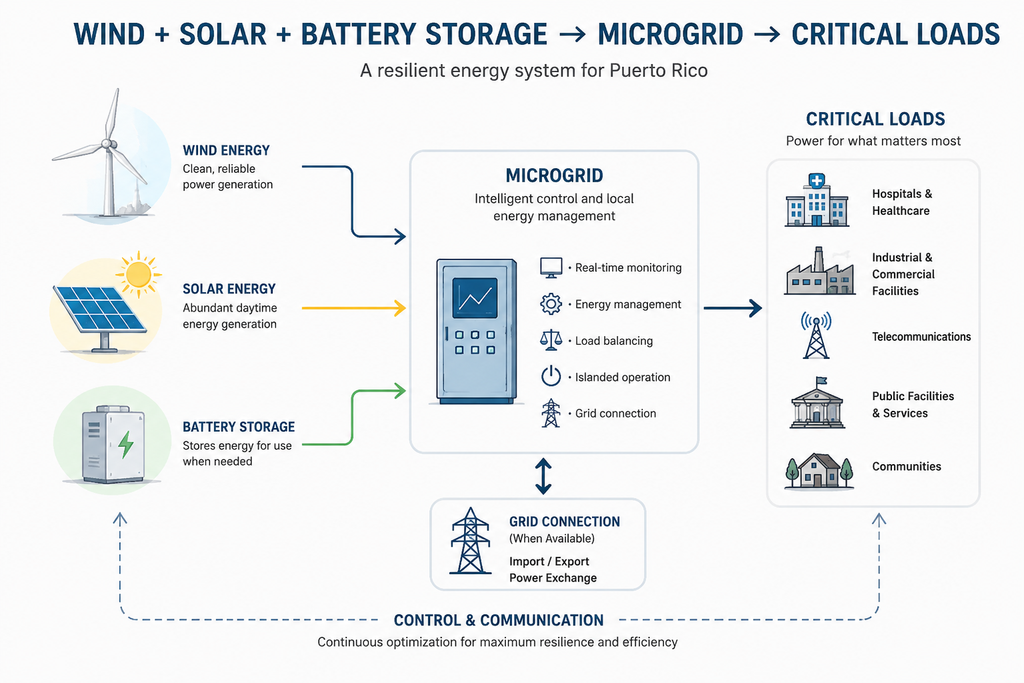
Northern Power Systems develops wind microgrid systems that integrate distributed wind generation into resilient local energy architectures.
For Puerto Rico, this approach can be particularly relevant for:
- critical services;
- hospitals and healthcare facilities;
- industrial and commercial sites;
- telecommunications infrastructure;
- public facilities;
- remote communities;
Microgrid resilience, however, depends on system design.
A project must consider electricity demand, critical loads, renewable resource availability, battery duration, grid interconnection, controls and the environmental conditions of the site.
Why Wind Energy Can Strengthen Puerto Rico Microgrids
Solar PV already plays an important role in distributed energy systems, but energy resilience does not necessarily require relying on a single renewable resource.
At sites with a suitable wind resource, wind energy in Puerto Rico can complement solar generation and battery storage.
Wind and solar have different generation profiles. Combining multiple renewable resources can therefore diversify electricity production and reduce dependence on one source.
Research involving Sandia National Laboratories has evaluated wind-solar-storage microgrids at several locations in Puerto Rico.
The analysis found that in areas with strong wind resources, integrating wind energy can reduce the amount of energy storage required compared with some solar-dominated configurations.
This does not mean that wind is always preferable to solar.
The optimal configuration depends on the site.
Wind resource, solar irradiation, electricity demand, land availability, storage requirements, grid conditions and project economics must all be evaluated before defining the final energy system.
Why Hurricane-Proof Wind Turbines Matter in Puerto Rico
Puerto Rico’s exposure to hurricanes creates another important requirement: renewable energy infrastructure must also be capable of operating in demanding environmental conditions.
This is where Northern Power Systems’ hurricane-proof wind turbines become particularly relevant.
NPS turbines are engineered for distributed energy applications and demanding environments, including islands, remote sites and hurricane-prone regions.
For Puerto Rico, hurricane-proof wind technology can provide a valuable component within a broader resilience strategy.
The objective is not simply to install renewable generation.
It is to build energy infrastructure that is:
- distributed;
- resilient;
- locally generated;
- compatible with hybrid systems;
- designed for demanding environmental conditions.
Wind, Solar and Storage: A More Diversified Energy System
A resilient renewable energy microgrid can combine several technologies.
Wind turbines generate renewable electricity where the wind resource is suitable.
Solar PV provides complementary daytime generation.
Battery energy storage stores electricity and helps balance renewable generation with demand.
Microgrid controls coordinate generation, storage, loads and interaction with the wider grid.
Together, these technologies can create a more flexible energy architecture than reliance on one generation source alone.
For Puerto Rico, the exact mix will vary from one project to another.
The important principle is diversification.
Proven Wind Technology for Caribbean Island Conditions
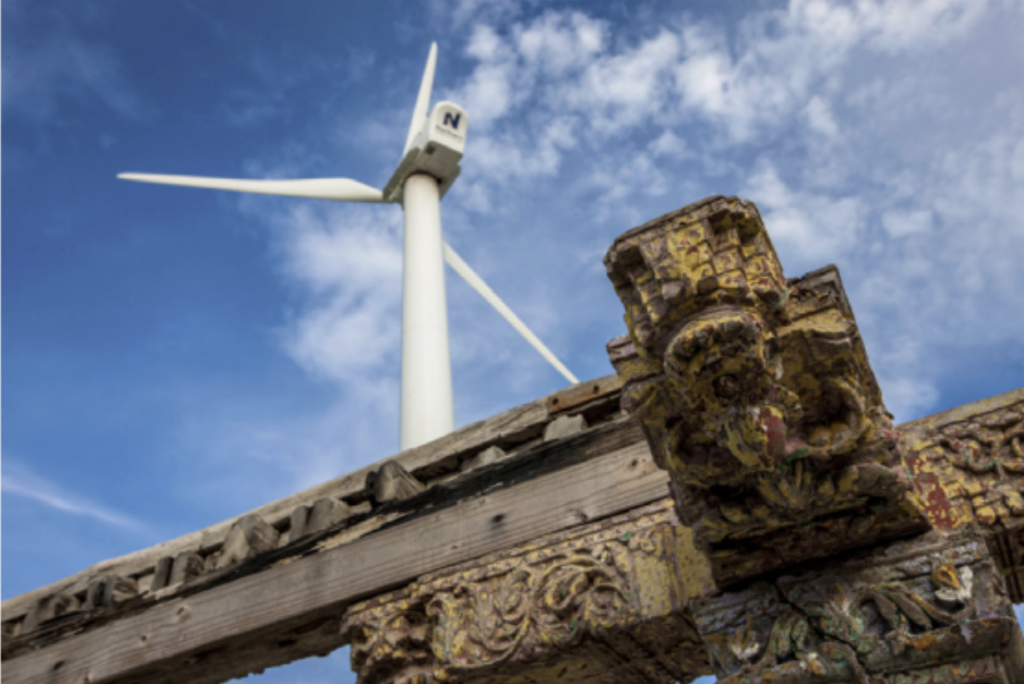
Northern Power Systems already has experience with wind energy in Caribbean island environments.
At Over Yonder Cay in the Bahamas, three Northern Power 100 kW wind turbines operate as part of a hybrid renewable energy system combining wind generation, solar PV and battery storage.
The first two turbines were installed before Hurricane Irene passed through the region in 2011 and survived the hurricane. A third turbine was subsequently added to the project.
The project demonstrates how distributed wind can operate as one component of a wider renewable energy system in an island environment exposed to severe weather.
Building Energy Resilience Across Puerto Rico and the Caribbean
Puerto Rico is not alone.
Across the Caribbean, island electricity systems can face a combination of extreme weather exposure, limited grid redundancy, imported fuel dependence and difficult energy logistics.
Distributed renewable energy can help address these challenges.
For suitable sites, hurricane-proof wind turbines, solar PV, battery storage and microgrid technologies can work together to strengthen local energy infrastructure.
The objective is not to replace the grid with one technology.
It is to create a more diversified and resilient electricity system.
Could Distributed Wind Support Your Puerto Rico Energy Project?
For developers, businesses and infrastructure operators evaluating energy resilience in Puerto Rico, the first question should not be whether wind, solar or batteries are universally better.
The right question is:
Which combination of technologies best fits the site, electricity demand, renewable resources and resilience objectives?
Where wind conditions are suitable, distributed wind energy from Northern Power Systems’ hurricane-proof wind turbines can complement solar PV, battery storage and microgrid systems to create a stronger local energy solution.
If you are developing a renewable energy, microgrid or resilience project in Puerto Rico or elsewhere in the Caribbean, contact Northern Power Systems to evaluate whether distributed wind is suitable for your site.