
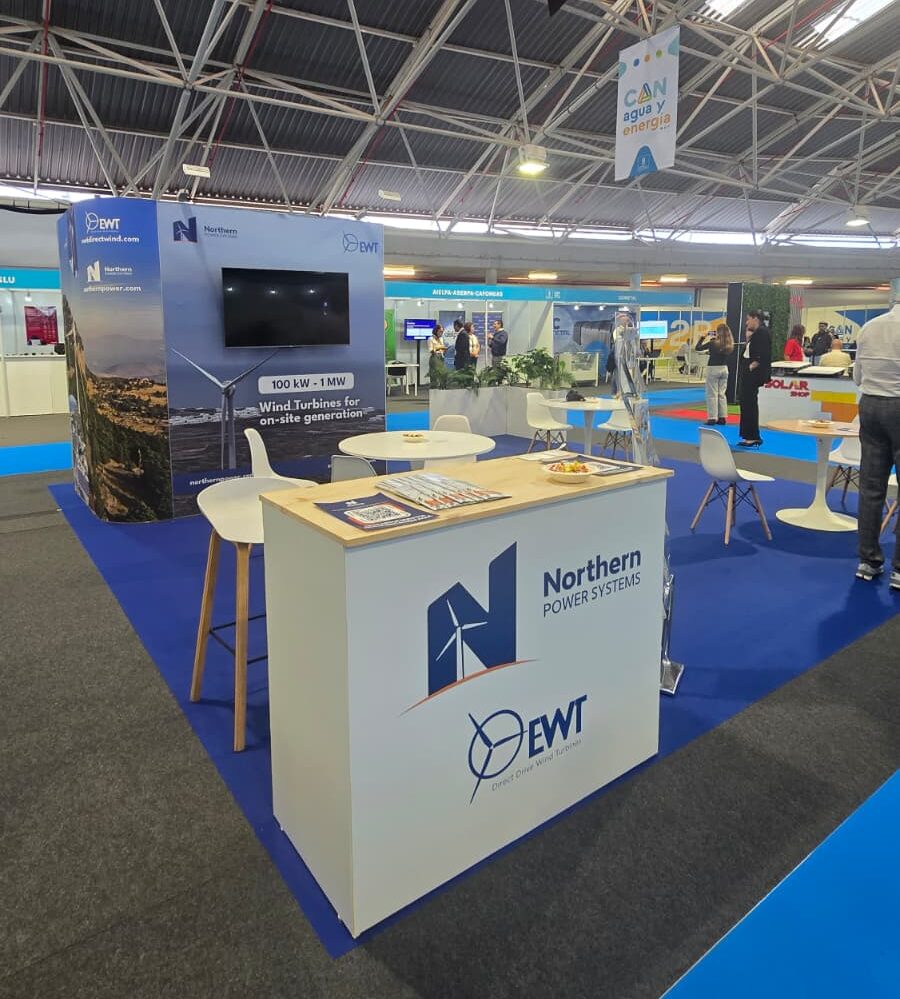
Northern Power Systems joined its partner EWT at CANAGUA y ENERGÍA 2026, held on 21 and 22 October at the Recinto Ferial de Agüimes in Gran Canaria.
According to the official CANAGUA y ENERGÍA 2026 event recap, more than 60 companies presented their products and services during the two-day event, alongside technical sessions and B2B meetings.
For NPS and EWT, CANAGUA y ENERGÍA 2026 was an opportunity to meet local stakeholders and discuss a practical question: how can wind energy projects move from planning to implementation when turbine availability, height restrictions, logistics and island grid conditions all influence technology selection?
Conversations throughout the event highlighted the importance of selecting wind turbines around the real constraints of each project rather than considering rated power alone.
CANAGUA y ENERGÍA 2026 and the Island Energy Challenge
CANAGUA y ENERGÍA 2026 focused on some of the central challenges facing the Canary Islands, including renewable energy integration, energy storage, efficient resource management and the transition towards cleaner island energy systems.
For NPS and EWT, these themes translated into conversations with developers, institutions and energy professionals about the practical requirements of wind projects.
There is no single configuration for island wind energy.
Wind resource, electricity demand, available land, grid characteristics, planning requirements, transport access and surrounding infrastructure can all influence the appropriate solution.
For islands, these considerations can be particularly important. Geographic isolation and dependence on imported fuels can increase the value of generating energy locally, while limited space and infrastructure can make technology selection more complex.
Wind Energy in the Canary Islands: From Planning to Turbine Availability
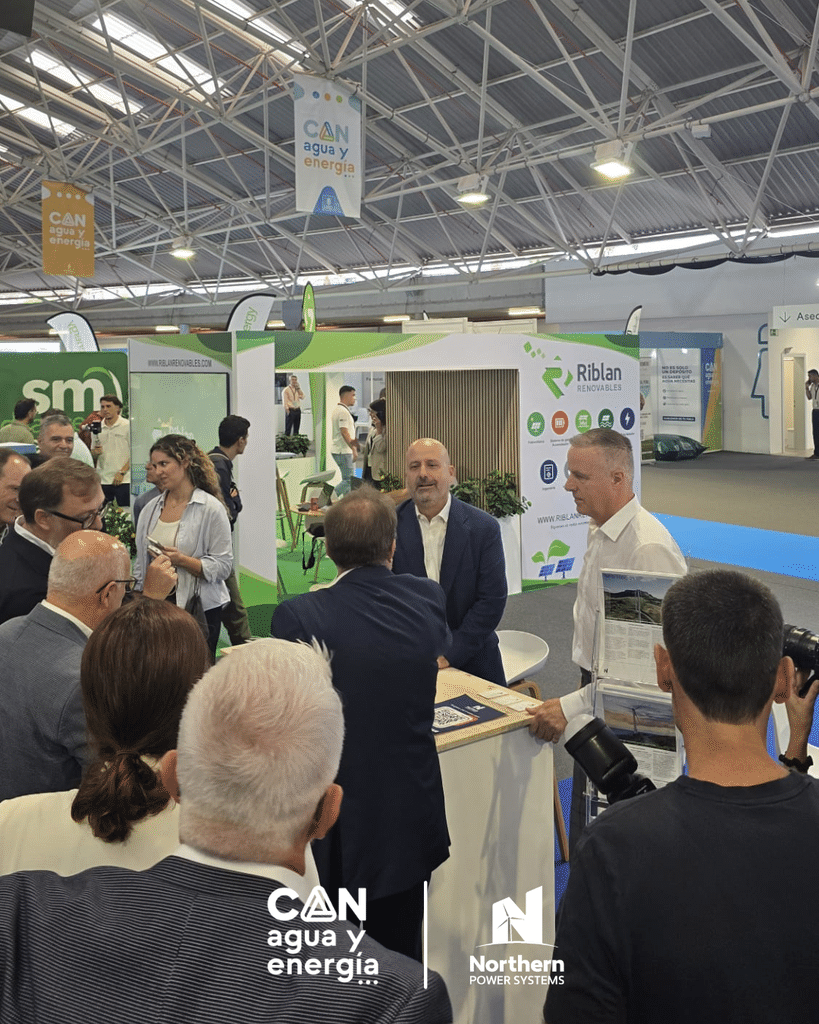
One of the highlights of CANAGUA y ENERGÍA 2026 was a visit to the NPS and EWT stand by representatives of Gran Canaria’s local government.
The discussion provided useful insight into some of the practical challenges affecting wind energy in the Canary Islands.
One issue raised was turbine availability.
A project can progress through planning and permitting based on a particular turbine configuration, but the originally considered model may no longer be available when the project reaches the implementation stage.
In that situation, identifying an alternative turbine is not simply a matter of selecting a machine with similar rated power. The replacement must also fit the site’s planning parameters, physical constraints and electrical requirements.
Height restrictions and airport-related constraints were another important part of the discussion. For sites affected by these limitations, turbine dimensions and tower height can significantly influence the range of technologies that can realistically be considered.
The conversation therefore highlighted the value of having established wind turbine technologies available across different power ranges.
NPS and EWT can address different project scales, including NPS 100 kW turbines and EWT turbines in the 1 MW class.
Why Turbine Size Matters for Island Wind Energy Projects
Wind turbine selection should start with the project requirements rather than rated capacity alone.
For an island project, developers may need to evaluate:
- available wind resource and expected energy production;
- electricity demand and load profile;
- grid strength and interconnection requirements;
- planning and height restrictions;
- available land and environmental constraints;
- proximity to airports and other infrastructure;
- turbine transport and installation access;
- operation and maintenance logistics;
- opportunities to integrate solar PV and battery storage.
These factors can make distributed wind energy particularly relevant where larger wind turbines are unsuitable or where generation is required close to the point of consumption.
Potential applications for 100 kW wind turbines can include commercial and industrial facilities, public infrastructure, agricultural sites and remote installations.
Larger turbines may instead be appropriate where available space, planning conditions, grid infrastructure and electricity demand support a higher-capacity project.
By exhibiting together at CANAGUA y ENERGÍA 2026, NPS and EWT were able to discuss different turbine sizes according to the requirements of each project rather than proposing a single solution for every site.
Wind, Solar and Storage in Hybrid Renewable Energy Systems
Another important theme at CANAGUA y ENERGÍA 2026 was the integration of renewable generation and energy storage within island energy systems.
Wind turbines do not have to operate as standalone assets.
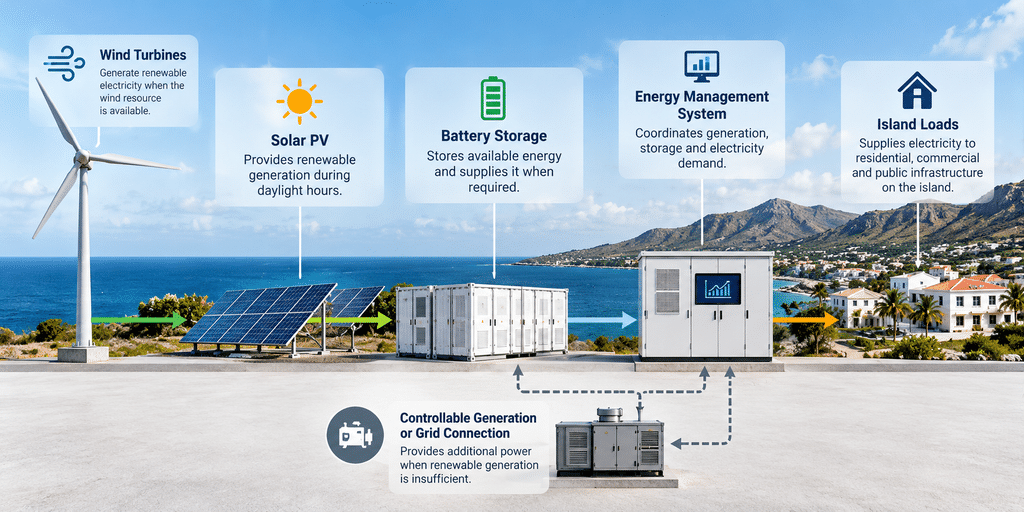
Depending on the site and electricity system, wind generation can be combined with solar PV, battery energy storage and controllable generation within hybrid renewable energy systems or microgrids.
Each component performs a different role:
- Wind turbines generate electricity when the wind resource is available.
- Solar PV provides generation during daylight hours.
- Battery storage can store available energy and supply it when required.
- Controllable generation or the grid can provide additional power when renewable generation is insufficient.
- Energy management systems coordinate generation, storage and electricity demand.
Combining multiple technologies can diversify local electricity generation and, where project conditions allow, reduce reliance on diesel generation.
However, the appropriate mix depends on local wind and solar resources, electricity demand, grid characteristics, storage requirements and the operational objectives of the project.
For island and remote-site applications, resource assessment and system-level engineering are therefore essential.
NPS Island Wind Experience: Pantelleria and the British Virgin Islands
Northern Power Systems has applied wind technology in different island environments, demonstrating how project design changes according to local infrastructure and operational requirements.
Pantelleria, Italy
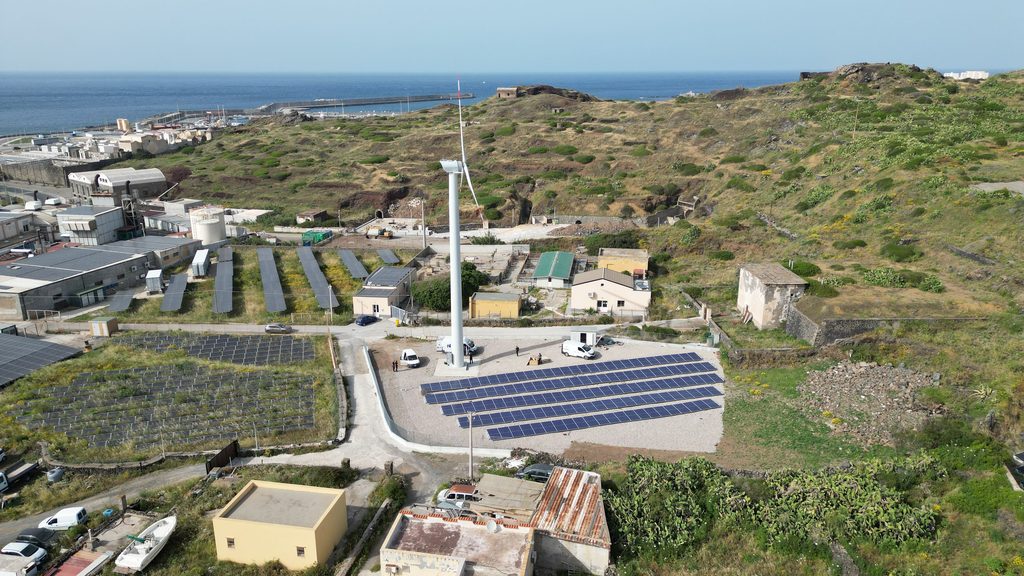
On Pantelleria, NPS installed an NPS100C-24 wind turbine on a 30-metre tower, replacing two smaller inactive turbines as part of a broader renewable energy redevelopment initiative for the Municipality of Pantelleria.
The project illustrates how existing island wind infrastructure can offer opportunities for replacement and modernisation rather than requiring every renewable energy project to start from zero.
British Virgin Islands
A remote island project in the British Virgin Islands presented a different set of challenges.
Three NPS 100 kW wind turbines were integrated into a hybrid renewable energy system alongside solar PV and battery storage.
The project also required engineering solutions suited to remote-site logistics and severe weather conditions, including ballasted foundations and hydraulic tilt-up towers.
These two projects demonstrate a common principle: successful island wind energy projects need to be designed around the specific conditions of the site.
What NPS Learned at CANAGUA y ENERGÍA 2026
The conversations in Gran Canaria reinforced several practical considerations for future wind projects in the Canary Islands and other island markets.
Technology availability matters from the beginning. A project that progresses through planning needs a turbine solution that can still satisfy its technical and planning requirements when implementation begins.
Rated power is only one part of turbine selection. Tower height, site access, grid conditions, logistics and nearby infrastructure can all influence the appropriate technology.
Different sites require different turbine scales. Distributed 100 kW wind and larger MW-class turbines can address different applications depending on electricity demand and site constraints.
Wind should be evaluated as part of the wider energy system. For many island applications, the most effective configuration may combine wind with solar PV, battery storage and existing generation rather than considering each technology separately.
These considerations are highly site-specific, which is why early technical evaluation can help developers identify suitable configurations before a project advances too far around a technology that may not ultimately fit its constraints.
From CANAGUA y ENERGÍA 2026 to the Next Island Wind Project
CANAGUA y ENERGÍA 2026 provided NPS and EWT with an opportunity to connect directly with the energy community in Gran Canaria and better understand the practical challenges facing wind energy projects in the Canary Islands.
Northern Power Systems would like to thank everyone who visited Stand SS05, shared their experience and discussed their projects with the team, as well as EWT for joining us throughout the exhibition.
The event may be over, but the project discussions continue.
Are you evaluating a wind energy project in the Canary Islands or another island or remote location?
Northern Power Systems can help assess the project requirements and identify a wind or hybrid energy configuration suited to the site’s wind resource, electricity demand, infrastructure and operational constraints.