
Why Wind Turbines for Islands Require a Different Approach
Wind turbines for islands can reduce dependence on imported diesel while providing locally generated renewable electricity, particularly when integrated with solar PV, battery storage and an appropriately designed island microgrid. However, successful island projects require technology and infrastructure designed around remote logistics, harsh coastal environments and, in some regions, extreme weather.
For many islands around the world, securing a reliable electricity supply is one of the greatest operational challenges. Unlike mainland locations, remote islands may operate as isolated microgrids and rely heavily on diesel generators to meet their energy demand. Diesel generation can expose these locations to fuel transportation costs, price volatility, maintenance requirements and supply-chain constraints.
The challenge becomes even greater in the Caribbean and other tropical regions, where hurricanes, salt-laden coastal environments and extreme weather conditions place additional stress on energy infrastructure. In these environments, resilience can be just as important as energy production.
Although island wind energy can provide an alternative source of locally generated electricity, conventional wind projects can be difficult to deploy in remote locations. Large foundations, heavy lifting equipment and complex logistics can increase installation complexity and project costs.
For more than 40 years, Northern Power Systems has designed wind turbines for islands and other off-grid applications where accessibility, reliability and resilience are essential.
The engineering approach can include ballasted foundations, hydraulic tilt-up towers, direct-drive permanent magnet generator technology and extreme-weather operating strategies, depending on the requirements of the individual project.
One example can be found in the British Virgin Islands, where three Northern Power Systems turbines form part of a hybrid renewable energy system designed to reduce diesel consumption while increasing energy resilience.
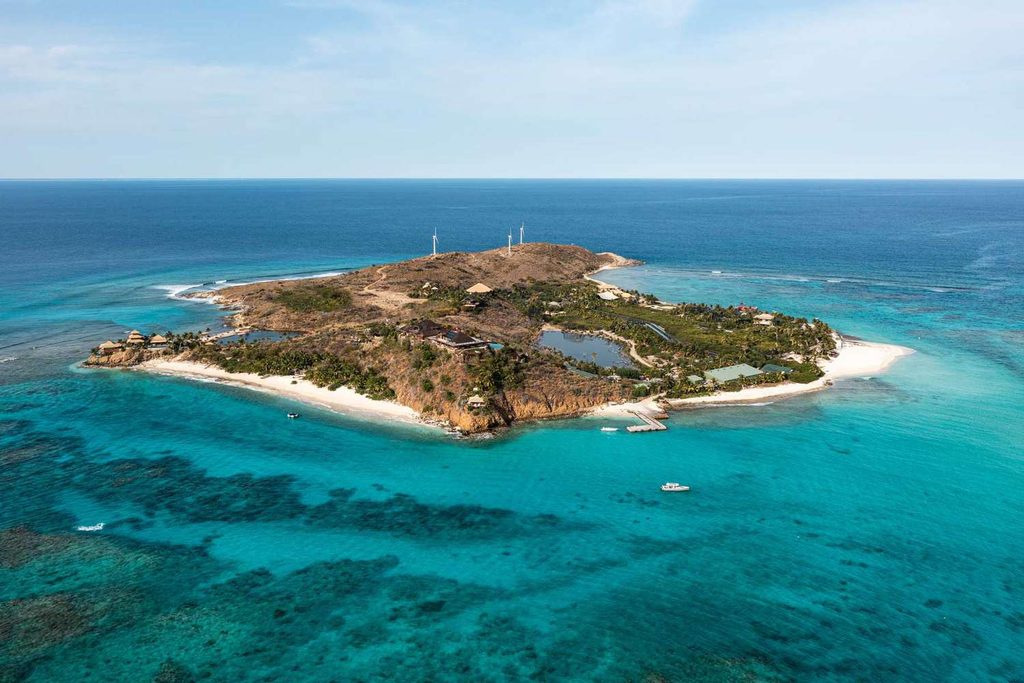
British Virgin Islands: 3 × 100 kW Wind Turbines
One of NPS’s most significant island installations is located at a luxury island resort in the British Virgin Islands. Completely isolated from the mainland electricity grid, the island must generate its electricity locally while maintaining reliable power for guests and daily operations.
Its Caribbean location also exposes the site to tropical storms and hurricanes, making resilience a critical consideration for its energy infrastructure.
Northern Power Systems supplied a wind energy solution designed around the logistical, operational and environmental challenges of a remote island.
The Challenge: Diesel Dependency, Logistics and Extreme Weather
Like many remote island sites, the resort historically depended heavily on diesel generators for electricity production. Fuel had to be transported to the island, creating additional logistics and exposing operations to fuel-price and supply risks.
Installing conventional wind infrastructure also presented practical challenges. Transporting construction materials and deploying large cranes on a remote island can significantly increase project complexity.
Finally, the system needed an engineering strategy for severe Caribbean weather, including the possibility of major hurricanes.
The Northern Power Systems Solution
Northern Power Systems supplied three NPS100C 100 kW wind turbines, providing 300 kW of installed wind capacity. The turbines were integrated with more than 1,230 solar PV panels and a battery energy storage system to form part of the island’s hybrid energy system.
This wind-solar-battery microgrid combines complementary energy resources: wind and solar provide renewable generation, while energy storage supports management of variable renewable output and electricity demand.
A key element of the wind project is the AFS 2000 ballasted foundation, developed with ARE Structures. Instead of requiring a conventional large concrete foundation, the system uses locally available material as ballast, reducing the quantity of construction material that needs to be transported to the island and simplifying civil works.
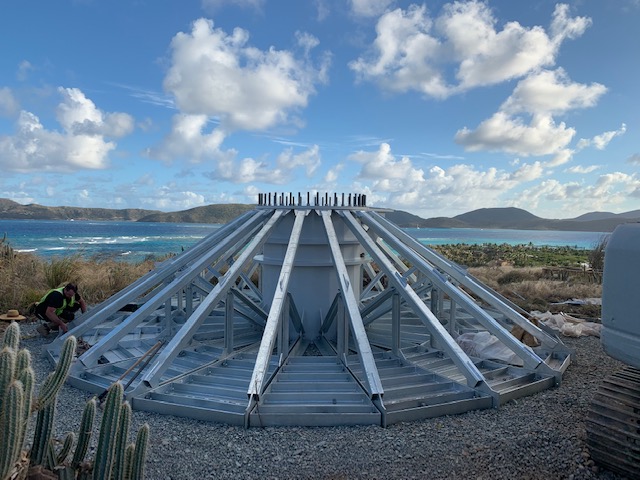
Each turbine is installed on a 22-meter hydraulic tilt-up tower. When severe weather approaches, the towers allow the turbines to be lowered, reducing their exposure to extreme wind loads. Once conditions are safe, they can be raised and returned to operation.
The project also provides a real-world example of how hurricane-proof wind turbines can be engineered for exposed island environments.
The tilt-up configuration also improves physical access to the turbine for inspection and maintenance.
Installation was designed around remote-site constraints. Turbine components could be transported in standard shipping containers and assembled on site without the very large crawler cranes commonly associated with utility-scale wind projects.
How Wind, Solar and Battery Storage Work Together
For remote islands, the value of wind generation is not limited to the turbine itself. Its contribution depends on how generation, storage, loads and any backup generation operate together as an island microgrid.
At this BVI site, the three 100 kW wind turbines operate alongside solar PV and battery energy storage. The combination allows renewable electricity to contribute to the island’s demand while reducing the electricity that needs to be produced from diesel.
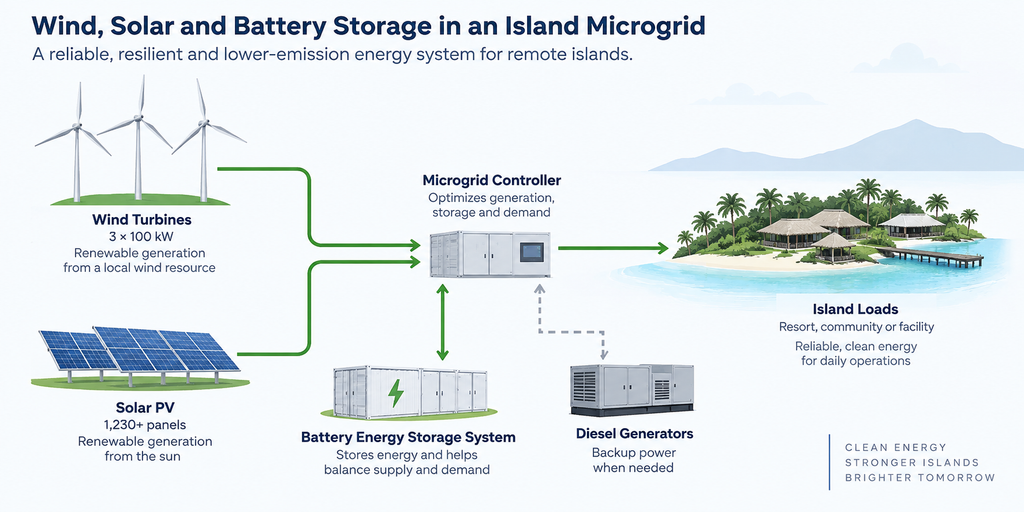
Actual system performance and the appropriate mix of wind, solar, storage and backup generation depend on site-specific factors including the wind resource, solar resource, load profile, required resilience, available land, logistics and project economics.
Measured Results
Since entering operation, the project has demonstrated the role that wind turbines for islands can play in a long-term hybrid renewable energy system.
Between 2020 and 2026, the three turbines generated more than 6.3 GWh of electricity, with average annual energy production of approximately 301 MWh per turbine. During the same period, average turbine availability was 98.6%.
Working with the island’s solar PV installation and battery energy storage system, the wind turbines have reduced the amount of diesel generation required.
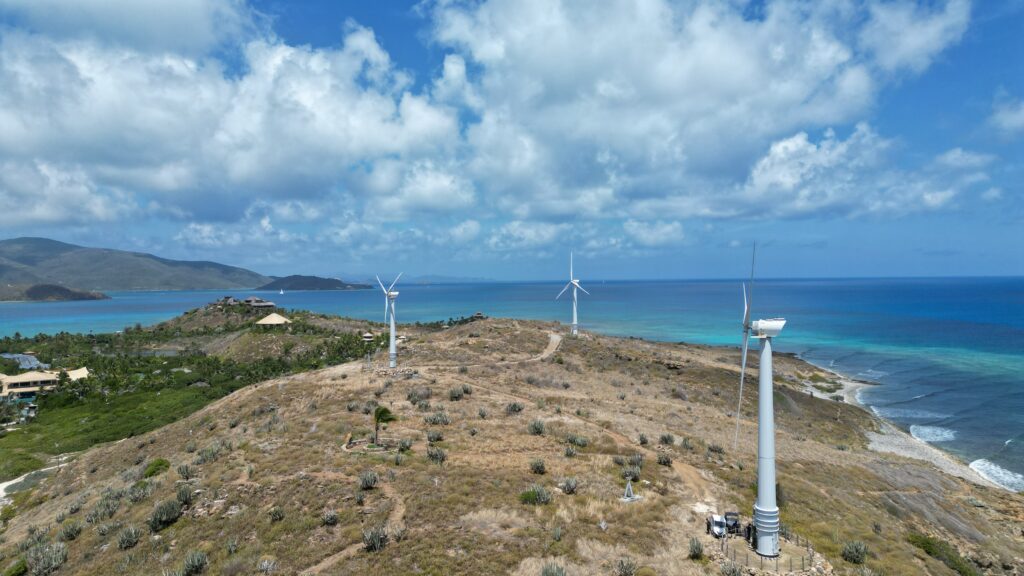
Key Benefits of Wind Turbines for Islands
The project illustrates several characteristics that can make distributed wind particularly relevant for suitable island sites.
Reduced diesel dependency. Local wind generation can reduce the amount of electricity that must be produced from imported fuel, lowering exposure to fuel transportation and supply constraints.
The U.S. Department of Energy also identifies distributed wind energy as a potential resource for remote and rural communities, including isolated and microgrid applications.
Remote-site installation. Containerized transportation, appropriate foundation solutions and installation methods that limit heavy-lifting requirements can make deployment more practical where access is difficult.
Extreme-weather strategy. At this project, hydraulic tilt-up towers allow the turbines to be lowered when severe weather approaches.
Hybrid renewable generation. Wind can complement solar PV and battery storage within an island microgrid, providing another locally available source of renewable electricity.
Maintenance access. A tilt-up tower can simplify access for inspection and certain maintenance activities compared with work performed at hub height.
When Does Wind Energy Make Sense for an Island?
A 100 kW wind turbine is not automatically the right solution for every island. Project feasibility depends on the site’s energy demand, measured or modelled wind resource, existing generation system, available space, environmental and permitting requirements, logistics and economics.
Wind becomes particularly relevant when a site combines a suitable wind resource with significant electricity demand and a desire to reduce reliance on imported fuel.
For hybrid projects, developers should evaluate the complete energy system rather than individual technologies in isolation. Wind resource assessment, load analysis, solar generation, storage capacity, backup generation and control strategy all influence the optimal system configuration.
For island resorts, remote communities, industrial sites and other isolated loads, this system-level approach can determine whether island wind energy provides a technically and economically appropriate contribution.
A Practical Blueprint for Remote Island Energy
The British Virgin Islands project demonstrates that successful renewable energy projects on islands require more than simply installing wind turbines. Technology, foundations, transportation, installation, maintenance and extreme-weather strategy must all reflect the realities of the site.
By combining 100 kW wind turbines with solar PV and battery energy storage, the project provides a practical example of how distributed renewable generation can reduce diesel dependency while supporting a more resilient island energy system.
Another NPS project in the Bahamas demonstrates how a renewable energy island resort can integrate wind generation into a remote energy system.
Northern Power Systems develops wind energy solutions for islands, remote communities and off-grid applications worldwide.
Planning an energy project for an island or remote site? Contact Northern Power Systems to discuss your site’s wind resource, energy demand, logistics and microgrid requirements and determine whether distributed wind could be a suitable part of your energy strategy.g to reduce diesel dependency and build a more resilient energy system, our team is ready to help.