
| Location | Columbus, Ohio, USA |
| Configuration | 1 x NPS100 |
| Rated Power | 100 kW |
| Rotor Diameter | 69 ft |
| Installation | 2010 |
A wind turbine for a dealership can do more than generate renewable electricity. When properly sited, it can reduce the amount of electricity purchased from the grid, make a company’s sustainability strategy visible and create an asset that customers immediately associate with innovation.
Byers Subaru demonstrated this approach in Columbus, Ohio, by installing a Northwind 100 commercial wind turbine. The turbine became operational in 2010 and was the first commercial wind turbine installed in Columbus.
The project shows how on-site wind energy can support both the operational and environmental objectives of an automotive retailer. It also highlights the importance of wind resource assessment, site selection, permitting and qualified installation
A Smart Investment in Wind Energy
Byers Auto Group was exploring ways to make its automotive facilities more sustainable. Alongside energy-efficiency measures and the use of environmentally responsible building materials, the company considered renewable electricity generation.
Wind energy offered three important advantages:
- production of renewable electricity directly at the dealership;
- strong visibility from nearby roads;
- a tangible demonstration of the company’s environmental commitment.
The group ultimately developed wind projects at two Ohio locations. A smaller turbine was installed at its Delaware site, while the Northwind 100 was selected for the Byers Mazda Subaru location in Columbus.
The Columbus dealership was particularly suitable because it was positioned at one of the higher points in the city and offered a better estimated wind resource.

A 100 kW Wind Turbine for a Dealership
The Columbus project uses a Northwind 100, a commercial wind turbine with a rated capacity of up to 100 kW.
The installation has the following key characteristics:
- Rated power: 100 kW
- Rotor diameter: 69 feet
- Total height reported by the dealership: approximately 150 feet
- Application: on-site electricity generation
- Operating location: Byers Subaru, Columbus, Ohio
- Commissioning period: autumn 2010
According to information published by Byers Subaru, the turbine was projected to generate approximately 150,000 kWh per year. Actual output in any period depends on the site’s wind conditions and the turbine’s operational performance.
The dealership also reported that the turbine could supply between 15% and 50% of its electricity demand at a given time, depending on wind speed and the facility’s load. This instantaneous contribution should not be confused with the annual energy share.
An NREL case study published shortly after commissioning reported an estimated annual electricity offset of approximately 15%–20% for the Northwind 100 installation.
NREL study of the Byers Auto Group project
Why Site Selection Was Essential
A successful wind turbine for a dealership must be based on more than available land or visual impact. The quality of the wind resource directly affects energy production and the economic performance of the installation.
During the development process, the project team considered:
- estimated wind conditions;
- nearby buildings and potential wind obstructions;
- turbine size and rated capacity;
- road and property setbacks;
- safety during construction and operation;
- visibility from surrounding areas;
- local planning and permitting requirements.
The project team initially considered installing the Northwind 100 at another dealership. However, the estimated wind resource at that location was not considered sufficient for the larger turbine.
The team therefore selected the Columbus site, which offered stronger estimated wind conditions. This decision illustrates an important principle for wind energy for businesses: the turbine must be matched to the site, rather than selecting a turbine before confirming the available wind resource.
For new projects, Northern Power Systems recommends a site-specific technical assessment. Depending on the location and project stage, this may include wind measurements, terrain analysis, nearby obstacle assessment, energy-consumption data and estimated annual energy production.

Five Business Benefits of On-Site Wind Energy
1. On-Site Renewable Electricity
The primary benefit of a wind turbine for a dealership is the ability to generate electricity at the point of use.
When wind conditions are suitable, electricity produced by the turbine can serve part of the dealership’s load. This reduces the amount of electricity that must be purchased from the grid during those periods.
The actual financial benefit depends on several factors, including:
- annual energy production;
- electricity tariffs;
- the proportion of energy consumed on-site;
- project financing;
- incentives available at the time of installation;
- operation and maintenance costs.
For this reason, savings and payback must always be calculated using current, site-specific data. Historical incentives or cost assumptions from the original Byers project should not be presented as applicable to a new installation.
2. A Visible Sustainability Commitment
Renewable electricity contracts and energy-efficiency improvements may not always be visible to customers. A commercial wind turbine creates a clear physical connection between the company and its sustainability strategy.
At the Byers site, the Northwind 100 became a recognisable feature of the dealership. Its position near a busy road helped communicate the company’s commitment to renewable energy to customers and the surrounding community.
This visibility can be particularly relevant for automotive retailers promoting electric and hybrid vehicles. The turbine demonstrates that the dealership is not only selling new mobility technologies but is also investing in renewable energy infrastructure.
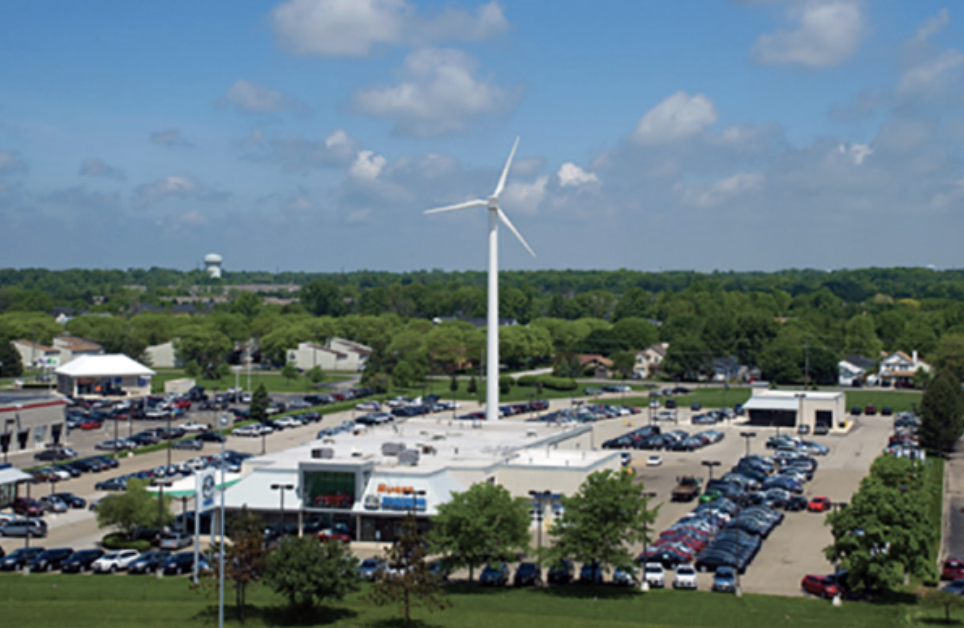
3. Customer and Community Engagement
The Northwind 100 attracted public attention after installation. George Byers Kauffman, Vice President of Byers Auto Group, reported that people visited the dealership because of their interest in the turbine.
The project also offered educational value. The installation was expected to support community visits and help explain how distributed wind energy works in a commercial environment.
However, the NREL report noted that the dealership did not collect data linking the turbine directly to vehicle purchases. It would therefore be inaccurate to claim a measurable increase in sales or conversion rates.
The supported conclusion is that the turbine generated interest, strengthened visibility and provided a practical demonstration of renewable energy.
4. Real-Time Performance Communication
Monitoring helps owners understand how a turbine is performing and how much electricity it is generating.
Performance information can also be communicated to employees, visitors and customers through screens, dashboards or sustainability reports. Depending on the available system data, businesses may present:
- current power output;
- cumulative renewable electricity generation;
- estimated grid electricity displaced;
- operational status;
- verified environmental indicators.
Any public claim about energy production, emissions avoided or financial savings should be based on validated data and a clearly documented calculation method.
5. Long-Term Energy Strategy
A commercial wind turbine is a long-term infrastructure investment. It should be assessed as part of a wider energy strategy that may include efficiency improvements, solar PV, battery storage, electric-vehicle charging and energy management.
For suitable sites, wind and solar generation can complement one another because their production profiles may differ by season and time of day.
The Byers project demonstrates how dealership renewable energy can extend beyond a single technology. The strongest projects begin with the site’s energy demand and objectives, then determine which combination of technologies offers the best technical and commercial fit.
Is a Commercial Wind Turbine Suitable for Your Business?
A commercial wind turbine may be suitable for a dealership, industrial facility or other commercial property when the site has:
- an adequate wind resource;
- sufficient distance from major obstacles;
- appropriate space and access;
- compatible planning and height requirements;
- significant on-site electricity consumption;
- a long-term interest in renewable energy generation.
Every project requires an individual assessment. The Byers Subaru results should therefore be treated as a real-world reference, not as a guaranteed forecast for another site.
Frequently Asked Questions
A wind turbine may supply part of a dealership’s electricity demand, but the percentage depends on the turbine, wind resource and consumption profile. At Byers Subaru, the Northwind 100 was estimated to offset approximately 15%–20% of annual electricity consumption.
The NPS100 installed at Byers Subaru has a rated capacity of 100 kW. Rated power is the maximum output under defined conditions and is not the same as continuous production. Annual energy generation depends primarily on local wind conditions
Normally, yes. Applicable requirements may include planning permission, height and setback rules, noise limits, building permits and grid-interconnection approval. Requirements differ between jurisdictions.
The Byers turbine generated substantial public interest and increased the visibility of the dealership’s sustainability efforts. However, no data were collected to prove that it directly increased vehicle sales.
The assessment should cover wind resource, energy consumption, surrounding obstacles, planning constraints, grid connection, expected annual production, project costs and operation and maintenance.
Build Your On-Site Wind Energy Project
The Byers Subaru case study shows how a wind turbine for a dealership can combine renewable electricity generation with a highly visible commitment to sustainability.
Northern Power Systems supports commercial and industrial customers through site assessment, turbine selection, project development, installation and long-term monitoring.
Explore our commercial and institutional wind energy applications or contact our team for a preliminary assessment of your site.